
I 751 Interview
I 751 interview. Learn what the I-751 interview involves, which questions USCIS asks, what documents to bring, and how to prepare for the removal
You open your mailbox and find a USCIS notice with your name, your spouse's name, and the words I-751 interview. Your stomach tightens. You may immediately wonder whether the notice means USCIS suspects fraud, whether you brought enough evidence, or whether one imperfect answer could end your permanent resident status.
Take a breath. An interview notice doesn't automatically mean USCIS plans to deny your case. It means the agency wants live testimony or additional clarification before deciding whether to remove the conditions on your residence. Many well-prepared couples attend this appointment, answer truthfully, and continue through the process without a problem.
The first point to understand is that not every Form I-751 case requires an interview. USCIS generally expects an interview, but officers can waive it when the written record is strong, consistent, and free of fraud concerns or unresolved complexity. The interview is therefore one possible path, not an unavoidable event for every conditional resident.
Table of Contents
- Understanding the I-751 Interview and Why It Exists
- How USCIS Decides Whether You Are Actually Interviewed
- Filing Window, Biometrics, and the Wait for a Notice
- Questions USCIS Commonly Asks at the I-751 Interview
- Documents to Bring and How to Organize Your File
- Common Misconceptions That Can Cost You the Case
- After the Interview and What Comes Next
Understanding the I-751 Interview and Why It Exists
Suppose Maria receives an interview notice several months after filing Form I-751 with her husband. She has already submitted joint bank records, tax documents, insurance policies, photographs, and proof that they live together. The notice doesn't erase that evidence. Instead, it tells Maria that an officer wants to verify the facts directly.
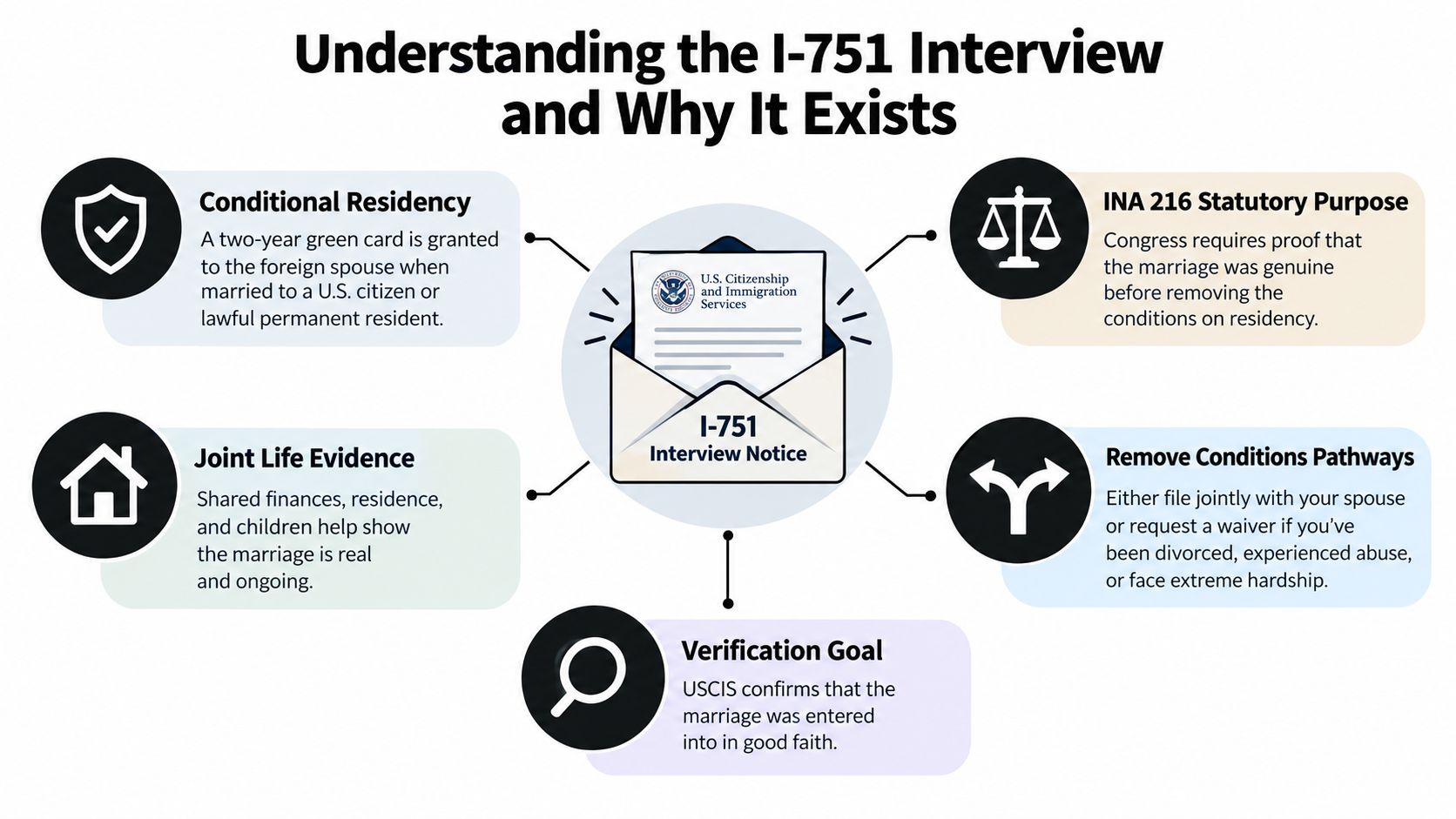
Form I-751 is the petition a conditional permanent resident uses to remove the conditions on residence after obtaining a green card through marriage. A conditional resident has permanent resident status subject to conditions tied to the qualifying marriage. In a joint case, the resident and the petitioning spouse file together during the 90-day period immediately before the conditional card expires, as explained in the USCIS Form I-751 instructions.
The phrase removal of conditions describes the transition from conditional residence to regular permanent residence. The purpose isn't to test whether a couple has a perfect marriage. USCIS wants to determine whether the marriage was genuine and entered into in good faith, rather than created primarily to obtain an immigration benefit.
What the filing does
A joint filer is the qualifying spouse who files the petition with the conditional resident. In a standard joint filing, both spouses generally must attend if USCIS schedules an interview. If the marriage has ended, or another recognized circumstance prevents a joint filing, the conditional resident may need to pursue a waiver-based filing instead.
Failing to file on time can put the resident's status at risk. USCIS states that the joint petition must be filed during the required filing window, and the petition addresses residence after the conditional card's validity period. A person who misses the deadline should obtain legal advice promptly rather than assuming the problem can be fixed informally.
Practical rule: The interview is not a performance. It's USCIS's opportunity to compare your live answers with the record you already submitted.
The officer may ask about your home, finances, relationship history, family life, and changes since filing. That doesn't mean the officer expects spouses to remember every minor date identically. USCIS is looking for a credible, coherent account supported by documents.
If you're unsure whether your case needs counsel, a guide to choosing an immigration lawyer can help you evaluate experience, communication style, and case fit before you schedule a consultation.
How USCIS Decides Whether You Are Actually Interviewed
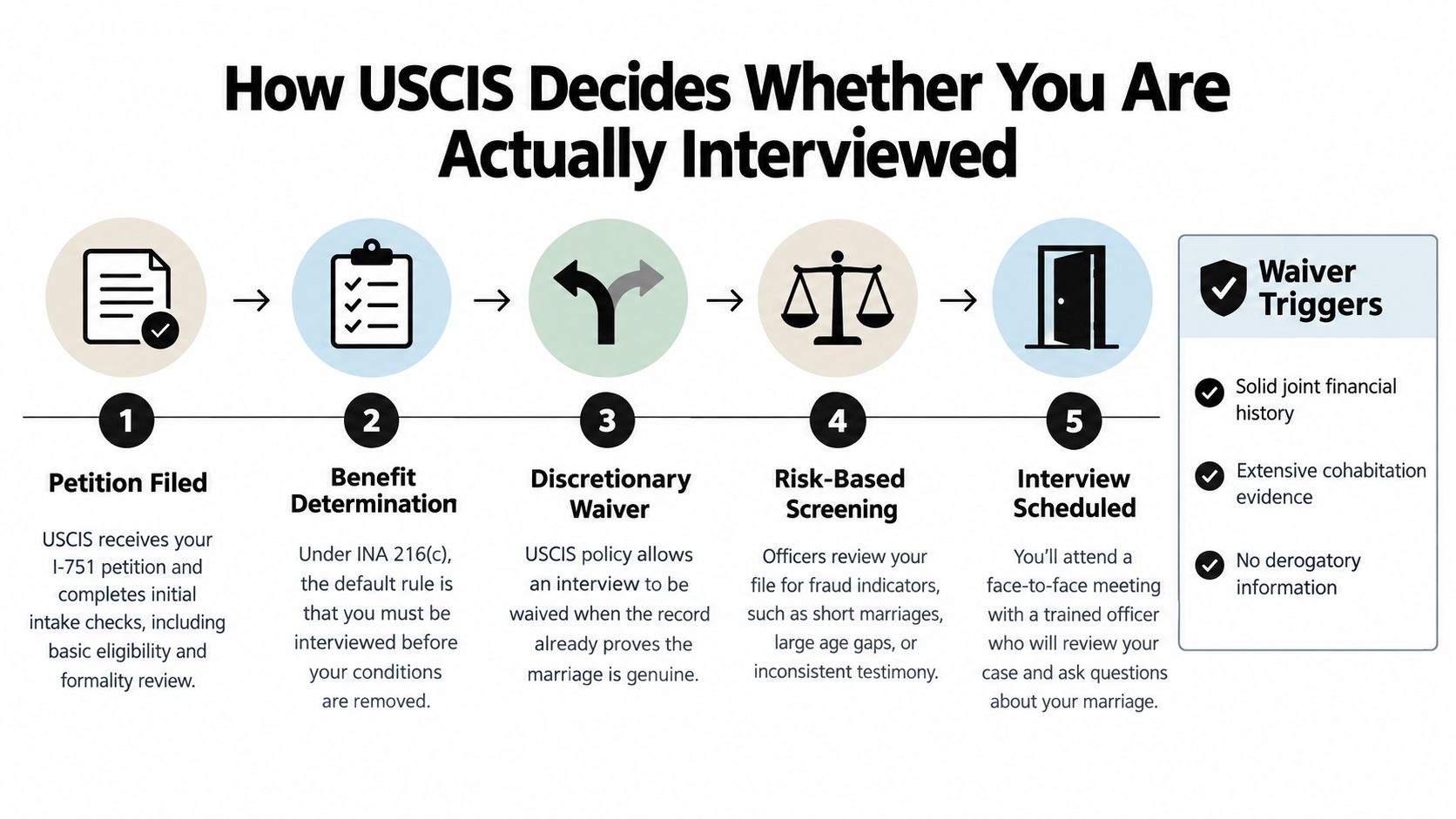
The confusing part of the I-751 process is that two statements can both be true. USCIS treats an interview as a general requirement, yet officers may waive it when the record gives them enough confidence to decide the petition without live testimony.
The policy moved toward that risk-based approach on December 10, 2018, when USCIS updated its guidance to allow officers to waive interviews in cases with strong records, no fraud or misrepresentation, and no complex issues. USCIS later confirmed another risk-based update on April 7, 2022. The USCIS policy guidance describes the factors officers consider when deciding whether a paper record is sufficient.
The shift matters because earlier practice was more interview-heavy. By the end of 2020, 58,371 Form I-751 petitions were pending that met the categorical interview requirement, according to the historical USCIS reporting referenced in its interview waiver update.
The officer's decision in practical terms
An officer is more comfortable waiving an interview when the petition tells one consistent story from beginning to end. That story normally includes:
- Complete filing: The petition and supporting evidence address the qualifying marriage and the resident's eligibility.
- Consistent history: Names, addresses, dates, and relationship details align with earlier immigration filings.
- Verifiable shared life: Financial, residential, family, and social records support the marriage.
- No unresolved concern: Background checks and the file don't reveal an issue requiring testimony.
- No complex facts: The officer can decide the petition without sorting out disputed or unusually complicated circumstances.
A thick packet alone doesn't guarantee a waiver. Five carefully chosen records that clearly establish a shared life may be more useful than a disorganized stack of repetitive pages. USCIS evaluates the quality and reliability of the record, not just its physical size.
For a joint petition, both spouses are generally expected to attend if USCIS schedules an interview. For a waiver-based filing, the conditional resident follows the attendance instructions in the notice, and the petitioning spouse may not be a joint participant.
The timeline is therefore straightforward in principle. The 2018 guidance broadened interview-waiver discretion, the 2022 update reinforced risk-based review, and officers now decide whether the written record is sufficient for the individual case. The notice you receive reflects that case-specific decision.
Filing Window, Biometrics, and the Wait for a Notice
A couple may file a joint Form I-751 only during the 90-day period immediately before the conditional green card expires, as explained in the USCIS filing instructions. Filing before that window can cause USCIS to reject the petition. A late filing can still be possible, but the applicant must explain the delay and provide supporting circumstances.
After accepting the petition, USCIS generally sends a receipt notice. Keep it with the conditional green card. The two documents work like a bridge between the expired card date and the pending petition, helping show the filing history and continued status while USCIS reviews the case.
Biometrics comes early
USCIS may send a notice for biometrics at an Application Support Center. The appointment commonly includes a photograph, fingerprints, and signature, which USCIS uses for identity and background checks. Read the notice closely, attend as instructed, and bring the identification and paperwork it lists.
If an emergency prevents attendance, act promptly. Follow the notice instructions and contact USCIS rather than missing the appointment. An unexplained failure to appear can delay the case.
Waiting requires case management
An I-751 may remain pending for a substantial period. Processing time varies with the service center, field office workload, filing basis, evidence, and any additional review USCIS considers necessary. A pending petition does not mean an interview is certain. Under the risk-based waiver approach, USCIS may decide the case from the written record and never send an interview notice.
Use the waiting period to keep your evidence file current. Save new records showing your shared residence, finances, family responsibilities, or other parts of your ongoing married life. Organize them as they arise instead of trying to rebuild the record shortly before an appointment.
If USCIS schedules a joint-petition interview, both spouses should plan to attend. If one spouse cannot appear, do not assume the conditional resident may attend alone. Request rescheduling or another available accommodation promptly, explain the reason, and keep proof of the request.
Questions USCIS Commonly Asks at the I-751 Interview
An officer usually asks questions for one of two reasons. The first group establishes the ordinary history of the relationship. The second group explores areas where the written record, prior filings, or the couple's circumstances need clarification.
The officer may compare your answers with the I-751 petition, the original marriage-based immigration file, and documents submitted over time. That's why internal consistency matters more than memorization. A spouse who gives a natural answer and admits not remembering a minor detail is generally in a better position than someone who guesses or recites an obviously rehearsed response.
Routine relationship questions
These questions help the officer understand how the marriage developed and how the couple lives together now.
| Question Type | Example Questions | What the Officer Is Verifying |
|---|---|---|
| Relationship history | How did you meet? When did the relationship become serious? Who proposed? | Whether the relationship has a plausible, coherent history |
| Marriage and family | When and where did you marry? Who attended? Do you have children? | Whether important events align with the petition and civil records |
| Shared residence | Where do you live? Who else lives there? How do you divide household tasks? | Whether the couple actually maintains a shared life |
| Finances | How do you pay household bills? Do you share accounts or insurance? | Whether financial responsibilities and records support the marriage |
| Daily life | What do you do on weekends? Who cooks or shops? | Whether answers reflect ordinary familiarity with one another |
| Social life | Which relatives or friends do you see? What did you do together recently? | Whether the relationship exists beyond the immigration paperwork |
A question about who usually pays the electricity bill isn't a test of romance. It helps the officer compare your description of daily life with utility records, bank statements, and the residence evidence in the file.
Second-look questions
The tone may change when the officer sees a gap in cohabitation, separate finances, conflicting addresses, or inconsistent dates. The officer might ask why you lived apart, why a document lists a different address, or why an earlier filing describes an event differently.
Separate questioning can occur when USCIS needs to compare testimony. That possibility doesn't mean denial is inevitable. It means the officer wants a clearer record, so answer directly, ask for clarification when needed, and never invent an answer to fill a memory gap.
Honest uncertainty is safer than a confident guess.
Language differences, cultural differences, and different memory styles don't automatically undermine a genuine marriage. Explain them plainly. If you need an interpreter, use one who can translate accurately and follow the appointment instructions.
Documents to Bring and How to Organize Your File
Bring the documents named in the interview notice first. Then add updated evidence that shows what has happened since filing. The officer should be able to understand what each document proves without searching through an unstructured pile.
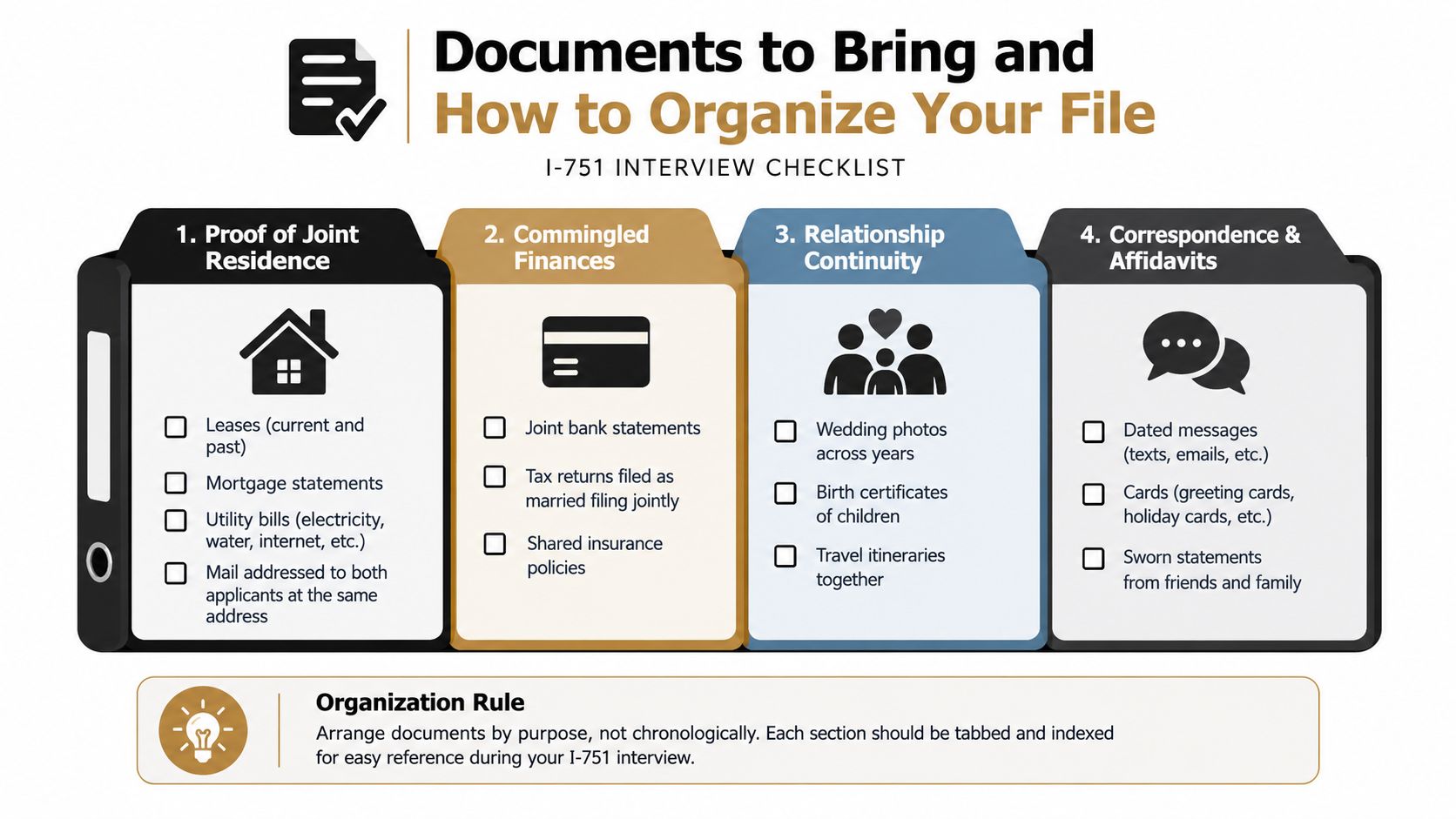
A portable folder works well when it is organized by purpose, not just by date. Create labeled tabs and place a short index at the front.
Evidence categories that answer specific questions
Joint residence helps show where the couple lives and whether the home is shared. Useful examples include leases, mortgage statements, utility bills, official mail addressed to both spouses, and records showing the same residence over time.
Commingled finances show how the spouses handle practical responsibilities. Consider joint bank statements, tax returns filed according to your circumstances, shared insurance, beneficiary designations, credit records, and major household purchases.
Relationship continuity fills in the human story around the financial records. Children's birth certificates, school or medical records, travel itineraries, photographs from different periods, and records of shared family events may help demonstrate an ongoing life together.
Identity and immigration history allows the officer to verify the people and the case. Bring the interview notice, passports, the conditional green card, the I-751 receipt notice, and a complete copy of the filed petition. Include prior immigration filings and relevant civil documents when they may clarify an answer.
Choose clarity over volume
You don't need to bring every photograph, receipt, or message you've ever exchanged. Select the strongest records in each category, especially documents that cover different periods and answer obvious questions about residence, finances, and shared responsibilities.
Before the appointment, add a one-page note identifying major changes since filing, such as a move, new job, child, period of separation, or financial change. If an earlier form contains an error, prepare a truthful explanation rather than hoping the officer won't notice it.
A consultation with an immigration lawyer can help you identify gaps, organize waiver evidence, and prepare explanations for inconsistencies without turning your answers into a script.
Common Misconceptions That Can Cost You the Case
The most important misconception is that every I-751 applicant will attend an interview. USCIS generally treats interviews as a requirement, but officers may waive them when the record is strong, the marriage evidence is sufficient, and there are no fraud indicators, complex facts, or relevant criminal concerns. A clean paper file can lead to a decision without an appointment.
The opposite misconception is just as harmful: some applicants believe that sending an enormous amount of paperwork guarantees a waiver or approval. It doesn't. USCIS assesses whether the evidence is relevant, credible, consistent, and sufficient to decide the petition.
What applicants often get wrong
- “We must answer every question identically.” Spouses may remember ordinary events differently. The concern is usually a meaningful contradiction about residence, finances, relationship history, or prior immigration information, not every minor detail.
- “An interpreter makes us look suspicious.” Accurate interpretation is more important than pretending to understand a question. Follow USCIS instructions and communicate clearly.
- “A notice means USCIS already decided against us.” The notice means the agency wants an in-person review. It isn't, by itself, a denial or a finding of fraud.
- “A denial ends everything immediately.” A denial can have serious consequences, but the next step depends on the written decision, the filing basis, the immigration history, and available procedural options.
The right preparation target isn't perfect performance. It's a record that remains truthful and consistent when the officer asks follow-up questions. Review the questions to ask before hiring an immigration lawyer if you're deciding whether your facts call for professional review.
After the Interview and What Comes Next
Leaving the field office doesn't necessarily mean the case is finished. USCIS may approve the petition, continue reviewing it, issue a Request for Evidence, send a Notice of Intent to Deny, or deny the petition in writing.
An RFE asks for specific documents or explanations. It might address missing marriage evidence, a change in circumstances, unclear answers, or a discrepancy between records. A NOID signals that USCIS has identified concerns that may lead to denial and gives the applicant an opportunity to respond before the agency makes its final decision.
A marriage can change while the case is pending
If the marriage ends, the conditional resident may need to change the filing basis. Potential waiver categories include:
- Battery or extreme cruelty: Evidence may support a waiver when the conditional resident experienced abuse by the petitioning spouse.
- Termination of the marriage: A divorce-based waiver may apply when the marriage ended and the resident can show the marriage wasn't entered into fraudulently.
- Extreme hardship: Certain hardship circumstances may support a waiver under the applicable rules.
- Good-faith circumstances involving wrongful control: The facts may require a careful legal analysis of whether the resident entered the marriage in good faith despite circumstances affecting the filing.
Don't conceal a separation, divorce, abuse, or refusal by the petitioning spouse to continue. Those facts can change the legal strategy, and continuing with an inaccurate joint filing may create a greater problem than addressing the change promptly.
Responding after an unfavorable development
Read every USCIS notice carefully and calendar the response deadline. An RFE or NOID is not the same as a final denial, but a weak or late response can leave USCIS with the existing record.
If USCIS denies the petition, review the decision with an immigration attorney. Depending on the circumstances, the case may involve a motion, an appeal to the Administrative Appeals Office, a new waiver strategy, or removal proceedings. The appropriate option depends on the denial's reasoning and the applicant's procedural posture.
Preparation protects more than the interview. A truthful, organized record also gives you a clearer foundation if USCIS asks for more evidence or the marriage circumstances change.
The goal isn't to predict whether an interview notice will arrive. It's to keep the petition accurate, current, and supported so you can respond responsibly whichever path USCIS chooses.
HeyAtty helps people describe their legal situation, compare vetted immigration professionals, review profile information such as experience, availability, and pricing, and book a consultation. Visit HeyAtty to find an immigration lawyer who can review your I-751 evidence, interview preparation, or response to a USCIS notice.