
How to Choose an Immigration Lawyer That Fits Your Case
Learn how to choose an immigration lawyer with the right experience, fees, and communication style for your specific case, with practical screening questions

You've just received an RFE on a pending I-140, your marriage-based interview is scheduled, or your employer has raised an urgent H-1B status question. The internet gives you dozens of names, polished websites, and promises of “personal attention.” None of that tells you whether a lawyer has handled your route, your risk pattern, and your next deadline.
The practical way to choose an immigration lawyer is to test three things: verified credentials, experience with cases materially like yours, and a working arrangement you can understand and afford. A lawyer with years in practice may still be the wrong choice if they rarely handle waivers, removal defense, RFEs, or the particular employment route you need.
Immigration work is paper-intensive, deadline-driven, and often discretionary. A wrong form, incomplete record, missed deadline, or weak legal explanation can create avoidable trouble. Use the questions below before you pay a retainer or send sensitive documents.
Table of Contents
- Why Picking the Right Immigration Lawyer Changes Everything
- Verifying Credentials Before You Share a Single Document
- Matching Experience to Your Exact Route and Risk
- Reading the Fee Agreement Like a Lawyer Would
- Flat Fee, Hourly, or Hybrid Billing Compared
- The First Consultation Questions That Reveal Fit
- Turning Your Shortlist Into a Confident Hire
Why Picking the Right Immigration Lawyer Changes Everything
You have an RFE, an upcoming marriage-based interview, an employer asking about H-1B status, or a removal case already in motion. Several lawyers may claim to handle immigration. The right choice depends on whether one has handled your route, your risk pattern, and your next deadline, not on how polished the website looks.
Use three filters:
- Credentials: Is the lawyer authorized to represent you, and can you verify current good standing?
- Case-specific experience: Can the lawyer describe recent matters involving your exact route and complications?
- Working style: Will the lawyer explain decisions, meet deadlines, answer questions, and define the service in writing?
Failing the first filter ends the conversation. Passing it does not justify a large retainer if the lawyer cannot explain how they handle your route. Ask for examples involving issues such as waivers, RFEs, credibility concerns, detention, removal defense, or employment-status problems when those issues apply to your case.
Immigration law punishes vague preparation
The work may involve forms, supporting records, translations, declarations, filing deadlines, interviews, agency correspondence, and litigation. Your lawyer must understand both the eligibility rule and how a specific fact could affect admissibility, status, credibility, or discretionary relief.
Ask what happens if the case stops being routine. An RFE response should address the agency's actual concern, not repeat the initial filing. A removal matter requires courtroom preparation, and detention experience may matter as well. Representation can materially affect outcomes: a TRAC analysis of more than 1.2 million deportation cases found that only 37% of immigrants overall and 14% of detained immigrants had representation. Represented immigrants were 5.5 times more likely to obtain relief from removal and 15 times more likely to seek relief, according to TRAC's analysis of representation and outcomes in immigration court.
Practical rule: Hire the lawyer who can explain the response plan when the case becomes difficult, not the lawyer who simply sounds confident.
Before sharing sensitive documents or paying a retainer, make the lawyer prove three things: the license is valid, the experience matches your route and risks, and the written fee agreement states exactly what the lawyer will do, what falls outside the scope, how communication works, and what triggers additional fees. Your first consultation is a risk check, not a marketing exercise.
Verifying Credentials Before You Share a Single Document
Before you send a passport scan, immigration history, or payment, verify who is legally allowed to represent you. In the United States, search the lawyer's full name and bar number in the relevant state bar directory. Confirm that the license is current, then review any listed discipline, suspension, or other public action.
If your case could involve immigration court, ask directly whether the lawyer handles removal defense and whether they can appear in the forum your case requires. A person who prepares forms may not be equipped for court hearings, detention matters, or other proceedings. Get that answer before you disclose sensitive records.
The U.S. Department of Justice EOIR attorney discipline program provides public information about disciplined immigration practitioners. Read the underlying record when available. If a lawyer says a disciplinary matter was “a misunderstanding,” ask what happened, how it ended, and what office procedure changed afterward.
Use the regulator, not the lawyer's website
For UK matters, verify a solicitor through the Solicitors Regulation Authority register. Check whether a non-solicitor immigration adviser is authorized under the appropriate OISC framework. In other countries, use the official bar directory or professional regulator, not a profile copied across legal directories.
Specialist credentials can provide a useful comparison point. California's immigration and nationality law certification application requires an applicant to have acted as principal attorney in at least 150 immigration cases within the prior five years, including at least 5 cases in each of two core categories, as described in the verified background material linked to the EOIR attorney discipline information. Certification is not required for every capable lawyer, but a documented case history gives you something concrete to examine.
Ask for the lawyer's regulator record, not a screenshot selected by the office.
A paid representative without authorization can put an application at risk. Canada's official guidance warns that an unauthorized paid representative can cause an application to be returned or refused. Keep the Government of Canada guidance link for the shortlist comparison later in the article, and require written terms before sharing information or paying.
| Jurisdiction | Primary source | Disciplinary record source | Notes |
|---|---|---|---|
| United States | State bar directory | State bar and EOIR discipline records | Confirm current license, discipline, and authority for the case type |
| United Kingdom | SRA register or applicable OISC authorization | SRA or relevant adviser regulator | Check both authorization and the scope of permitted immigration work |
| Canada | Provincial law society or authorized representative records | Provincial regulator and federal guidance | Confirm that a paid representative is authorized before retaining them |
Before any document leaves your hands, complete three checks:
- Identity: Match the lawyer's full legal name, office details, and regulator record.
- Standing: Confirm current authorization and review public discipline information.
- Authority: Verify that the person can represent you in the specific forum and matter involved.
If the record cannot be verified, stop. Do not proceed with the consultation just to see what happens.
Matching Experience to Your Exact Route and Risk
A lawyer may have practiced immigration law for years and still be a poor fit for your case. Ask about the same route and the same complication. Someone who regularly handles routine I-130 petitions may not be prepared for an I-751 waiver, I-589 asylum filing, I-140 RFE, N-400 issue involving prior conduct, or removal proceedings.
Look for specific knowledge of the form series, supporting evidence, filing order, and predictable trouble spots. Ask which service center, consulate, or court handles comparable matters, and what RFEs or interview problems the office has seen on that route. The lawyer's recent caseload should resemble your case, not merely include “immigration” on a website menu.
Ask for recent, specific experience
Start with: “How many cases of this exact type have you handled recently?” Require a separate answer for your route and complication. A combined number covering every immigration matter in the office tells you very little.
Then ask:
- RFE experience: “What issues have caused RFEs in cases like mine, and who writes the response?”
- Denial experience: “When a comparable case was denied, what was the reason and what did you do next?”
- Hearing experience: “How many similar hearings have you taken through completion?”
- Supervision: “Will you personally review and sign the filing, or will another attorney do that?”
Do not request confidential client details. You are testing whether the lawyer can explain patterns, decisions, and process without hiding behind generalities.
Courtroom experience deserves separate scrutiny. TRAC's study of more than 1.2 million deportation cases found a strong association between representation and access to relief, particularly in detention and removal matters. That finding cannot predict your individual result. It does show why verified experience in the actual forum matters more than a promise to “fight for you.”
For a broader guide to what kind of lawyer you need, apply the same test to specialization. The right lawyer's recent work should match your route, forum, and risk pattern.
Ask this bluntly: “What is the hardest part of my case, and which similar matter recently required you to solve that problem?”
A generalist may suit a straightforward family petition. Choose someone with directly relevant experience when your case involves a waiver, prior refusal, disputed facts, criminal history, detention, or a deadline-sensitive response.
Reading the Fee Agreement Like a Lawyer Would
You leave the consultation believing the interview is included. The agreement later says it is not. Treat that document as the description of the service. Clear explanations in a meeting do not repair vague written terms.
The scope must name the work covered: a particular application, petition, interview, hearing, motion, or appeal. “Immigration services” says too little. Require the agreement to state whether the lawyer will prepare forms, organize evidence, draft declarations, contact the agency, attend an interview, answer an RFE, and handle work after a decision.
Find the triggers for extra charges
Read for the events that move work outside the base fee. Ask these questions before signing:
- Evidence requests: Is an RFE response included, excluded, or billed hourly?
- Interviews: Does the fee cover preparation, attendance, or both?
- Problems after filing: What happens after a denial, notice of intent to deny, or notice to appear?
- Changed circumstances: Does a job loss, marriage breakdown, arrest, or address change start a new engagement?
- Court work: Are motions, hearings, appeals, and custody matters separate services?
The agreement should list the base fee, hourly rate for additional work, payment dates, government filing fees, translation costs, courier charges, and other expenses. “Miscellaneous costs” is not a usable budget. Ask the lawyer to define each charge or remove the vague wording.
Pricing disputes often begin with unclear scope. The UK Legal Ombudsman's immigration thematic report recorded 230 accepted complaints in 2019/20, with 22% of remedies fee-related, according to the Legal Ombudsman immigration report. Put the pricing rules in writing before the relationship starts.
Before signing, review how a legal consultation fee is typically structured so you can separate consultation charges from representation costs.
Refuse verbal-only promises
If the lawyer says, “I'll include the interview,” ask for that sentence in the agreement. If RFEs are “usually covered,” ask for a definition of “usually.” If the lawyer will keep the file open after a denial, require the agreement to state what that work includes and what it costs.
For practical guidance on what a consultation may cover and how to prepare, read this immigration lawyer consultation guide. Before signing, answer one question without guessing: What exactly am I buying, and what will cost more?
Flat Fee, Hourly, or Hybrid Billing Compared
Billing structure should follow case predictability. A routine, clearly defined filing often fits a flat fee because the lawyer can identify the work in advance. A removal defense case, complex waiver, federal court matter, or case with uncertain agency action may need hourly billing or a staged arrangement.
Public guidance describes U.S. flat-fee bands that can range from roughly $1,000 to $15,000 or more, depending on case type and complexity, with additional charges possible for government filings, document requests, and ongoing communication, according to this immigration attorney cost guide. Treat that as market context, not a quote. Your written scope matters more than a broad range.
| Structure | Best for | Payment mechanics | Client risk |
|---|---|---|---|
| Flat fee | Defined filings with predictable work | Pay all or in stages under a written scope | Extra work may fall outside the package |
| Hourly | Removal defense, complex disputes, litigation, uncertain responses | Retainer is applied against time billed | Total cost can rise as complications develop |
| Hybrid | Matters with a predictable core and uncertain next steps | Flat fee for defined stages, hourly or capped charges for exceptions | Ambiguous triggers can create surprise invoices |
A flat fee is not automatically safer. It becomes dangerous when the lawyer calls it “flat” but excludes the work most likely to matter, such as an RFE response, interview attendance, motion, or appeal. Hourly billing isn't automatically unfair either. It can be the more honest structure when nobody can predict how much court preparation or evidence development the case will require.
The right choice follows the route filter. If the case is straightforward and tightly defined, demand a complete flat-fee scope. If the case contains disputed facts or potential litigation, ask for hourly terms, staged billing, or a clear cap for defined tasks. In England and Wales, the SRA transparency guidance makes early cost information an important part of client communication. Wherever you are, insist that the agreement explains what happens when the case changes.
The First Consultation Questions That Reveal Fit
A productive consultation starts with diagnosis, not a sales pitch. The lawyer should ask when you entered the country, what status or visa you held, whether you've contacted immigration authorities before, whether you've filed applications previously, and whether there's any arrest, charge, removal order, prior refusal, or misrepresentation issue.
If the lawyer quotes a fee before asking about those facts, slow down. They may be quoting a package before understanding the risk.
Use this interview sequence
Ask the questions in this order:
“How many cases exactly like mine have you handled recently?”
Listen for a route-specific answer. “We handle lots of immigration cases” tells you almost nothing.“What are the difficult facts in my case?”
A competent lawyer should identify missing records, timing concerns, admissibility questions, credibility issues, or evidence gaps.“What is your approval rate, and how do you calculate it?”
Be wary of a polished percentage without a defined denominator. Ask whether it includes only accepted cases, whether abandoned matters are excluded, and whether the lawyer is discussing their own files or the office's entire practice.“Who prepares the filing, and who reviews and signs it?”
A paralegal may assemble documents, but you need to know which attorney is responsible for legal analysis and final quality control.“What timeline can you control, and what depends on the government?”
The lawyer shouldn't promise an outcome or pretend to control agency processing. They should separate their preparation schedule from government processing time.“What happens if we receive an RFE, denial, or notice to appear?”
Ask whether that work is included, separately billed, or handled by another lawyer.“Who attends the interview or hearing?”
Get the person's name and role. Don't assume the attorney you meet will appear with you.
Pay attention to the meeting itself
A good consultation feels organized. The lawyer listens, asks follow-up questions, explains uncertainty, and tells you what records are needed next. A bad one feels like a rushed product demonstration.
Watch for:
- Vague timing: “It should be quick” without separating lawyer work from agency processing.
- Guaranteed results: No ethical lawyer can guarantee approval, a visa, or a particular court outcome.
- Pressure to sign: You don't need to sign because the office says the price expires today.
- Unclear staffing: Nobody can tell you who will draft, review, or attend.
- Written-scope resistance: The lawyer won't put verbal promises into the engagement letter.
Language access matters too. If you need interpretation, ask whether the office provides it, whether it costs extra, and who will translate legal instructions. Ask when calls and emails are answered, whether urgent deadlines have a separate process, and how you'll receive copies of filings and notices.
A lawyer who handles your questions patiently before payment is showing you the service style you'll receive after payment.
End the consultation by asking for the proposed engagement letter and a written list of documents needed. Then compare that package with at least two alternatives. The lawyer who gives you the most confident prediction isn't necessarily the best hire. The lawyer who identifies the risk, defines the next step, and documents the arrangement is usually the safer choice.
Turning Your Shortlist Into a Confident Hire
You have three candidates who all sound capable. Their websites look polished, and each promises personal attention. The deciding test is whether one lawyer can explain your exact route, identify its failure points, and put the promised work in writing.
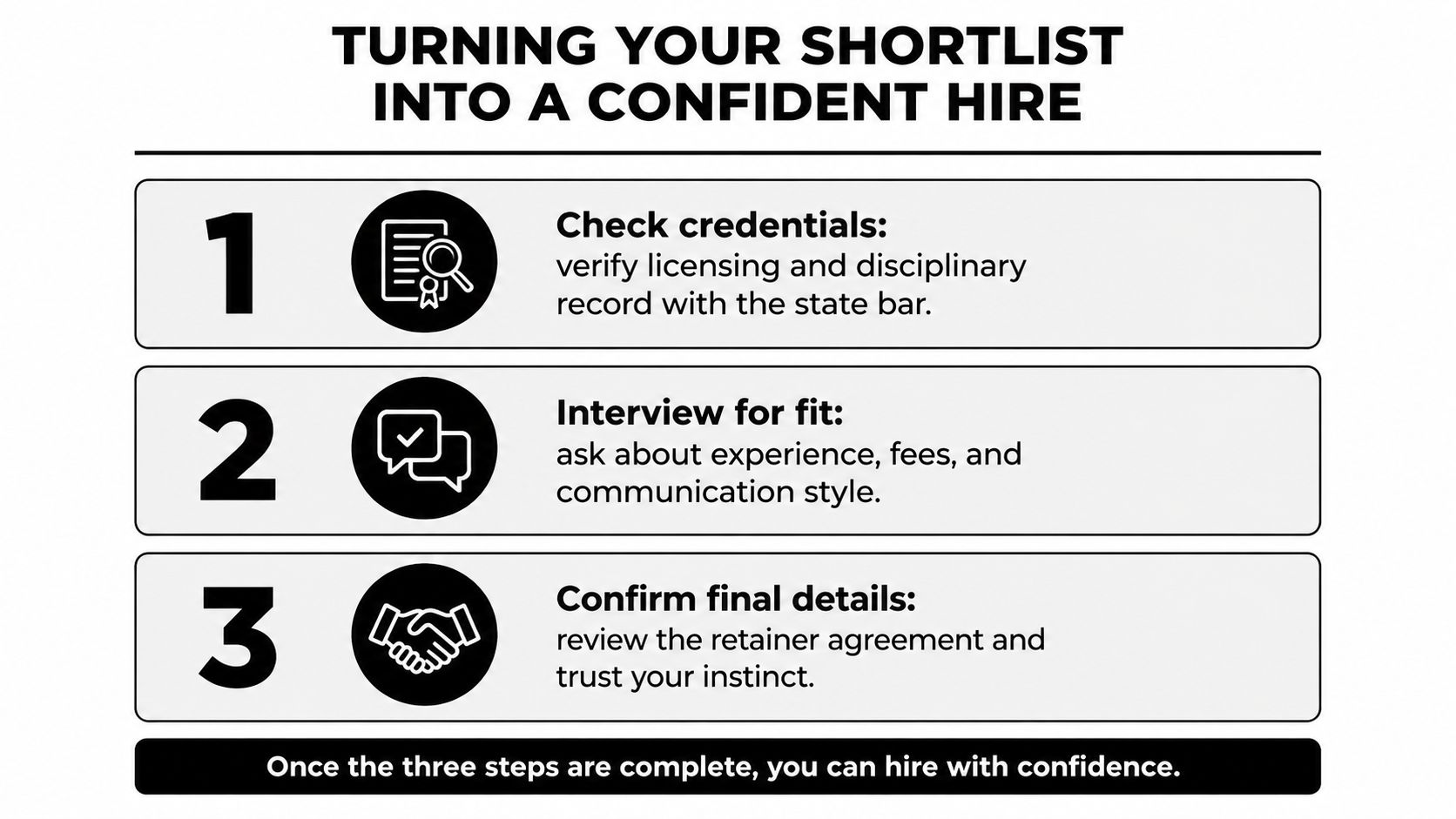
Use the same final checklist for every candidate:
- Confirm authorization and discipline. Save the regulator's record, not just a profile screenshot. Confirm that the lawyer is authorized for the forum handling your matter and has no unexplained disciplinary history.
- Match recent work to your risk pattern. Ask how recently the lawyer handled your route and cases involving RFEs, denials, hearings, waivers, interviews, or prior filings. Write down the answers. General immigration experience is not enough.
- Compare written agreements side by side. Mark the defined scope, base fee, payment schedule, government fees, add-on triggers, hourly rates, communication terms, responsible attorney, and termination provisions.
The fee agreement must state who does the work, who reviews it, who communicates with you, and what happens if the relationship ends. It should also identify work outside the quoted scope, the rate for that work, and expenses you may have to pay separately. If the office will not name the attorney of record or explain termination, do not sign.
Your comparison should cover verified profiles, pricing, availability, and relevant experience, not just a persuasive sales call. HeyAtty is one marketplace option with structured profiles and guided intake for comparing legal professionals before booking.
Before signing, answer three questions: Why does this lawyer fit your route? What will they do if the case becomes difficult? What will you pay at each stage? The regulator record, consultation notes, and written agreement should answer all three. If they do not, keep interviewing.
Use HeyAtty to describe your immigration matter, compare legal professional profiles, and review available pricing and booking details before reaching out. Start with lawyers whose documented experience matches your route and risk pattern, then bring the written agreement to the consultation and ask about every unclear term.