
Immigration Lawyer Consultation: Cost & Prep Guide
Learn what to expect in an immigration lawyer consultation and how to prepare. Get expert advice to maximize your 2026 meeting with an attorney.

You've got the folder open, the calendar marked, and the knot in your stomach still hasn't gone away. Maybe you were laid off last week, maybe your status is close to expiring, or maybe you've got an old visa denial, a travel gap, or a family change that you can't untangle on your own. That's exactly when an immigration lawyer consultation matters, because the first conversation is often where a lawyer decides whether you need a filing, a rescue plan, or a hard stop before you make things worse.
Table of Contents
- Why Your First Immigration Consultation Matters More Than You Think
- What Happens During a Typical Immigration Lawyer Consultation
- How to Prepare Documents and Timelines Before Your Meeting
- When to Pay for a Consultation Versus Using Free Legal Resources
- Handling Urgent Scenarios Like Layoffs and Status Expirations
- Evaluating the Lawyer and Deciding on Next Steps After the Session
- Finding and Booking the Right Immigration Lawyer Quickly
Why Your First Immigration Consultation Matters More Than You Think
I've watched people walk into their first meeting with a stack of papers and no timeline, then leave with nothing useful because the lawyer spent the entire session sorting the mess. I've also seen prepared clients get a clean answer in one sitting, because they knew the facts, brought the right documents, and asked the right questions.

A consultation is not a friendly meet-and-greet. It is a triage session, and in immigration matters triage is everything. The lawyer is trying to figure out your current status, what already happened, what deadline is looming, and whether you have any path to relief before time runs out.
That matters even more in a system where demand is huge and representation is thin. TRAC reported that the share of immigrants with counsel in pending removal cases fell from 65% five years earlier to 30% in 2024, while Vera found 67% of people facing deportation lacked legal counsel and immigration courts had 3.4 million pending deportation cases. TRAC also reported 1.4 million immigrants were represented in FY2024, but only 16,976 representatives handled those cases, which tells you how concentrated immigration legal capacity is. Those figures are from the same reporting ecosystem that highlights why first consultations are so consequential, because a lot of people need an initial legal assessment before they know whether they even have a viable case. TRAC's immigration counsel report
Practical rule: if you spend the consultation explaining your whole life story but never get to dates, documents, and deadlines, you've wasted the most valuable part of the meeting.
The right mindset is simple. Don't show up hoping the lawyer will “figure it out” from fragments. Show up ready to give them enough structure to answer the core question, which is not “Do I need a lawyer?” but “What should I do next, and how fast?”
What Happens During a Typical Immigration Lawyer Consultation
A good consultation follows a predictable arc. First comes intake, then document review, then issue spotting, then strategy, then pricing for next steps. If a lawyer skips straight to a sales pitch or talks in circles without identifying the legal problem, that's not a consultation, that's noise.
The short call and the deep-dive are not the same thing
Many firms offer 15 to 30 minute free consultations for basic triage. That format can work if your issue is straightforward and you only need a quick sense of whether you're in the right lane. Published fee schedules also show that paid consultations are usually 45 to 90 minutes, which gives the lawyer room to review documents, spot problems, and explain strategy in a way a free call usually can't. Across market examples, standard initial consult pricing clusters around roughly $100 to $400, with more complex matters priced higher because the lawyer needs to assess risk before advice is reliable. Consultation fee structures and market pricing
A lawyer should use that time to answer specific questions, not deliver a generic overview of immigration law. If the case involves removal defense, employment-based filings, or a messy history, the lawyer needs enough time to map the facts against the law, and that takes longer than a fast intake call.
Immigration consultation formats at a glance
| Format | Duration | Purpose | Typical Cost |
|---|---|---|---|
| Free triage call | 15 to 30 minutes | Basic screening, fit check, quick next-step guidance | Free |
| Paid initial consultation | 45 to 90 minutes | Document review, issue spotting, strategy, fee estimate | Roughly $100 to $400 |
| Complex matter consultation | Often longer than a standard consult | Deeper analysis for removal defense, business cases, or document-heavy files | Higher than routine consults |
The exact format should match the complexity of your issue. A simple status question doesn't need a long strategy session, but a case with prior denials, travel issues, or a looming expiration absolutely does.
A strong consultation ends with clarity on the next move, not with vague encouragement.
If you walk out without knowing your likely options, what documents still matter, and what the next filing or deadline looks like, the session didn't do its job.
How to Prepare Documents and Timelines Before Your Meeting
Preparation is where people lose the most money. A lawyer can't give reliable advice if you show up with random paperwork and no sequence of events. Immigration cases live or die on chronology, so your job is to make the chronology easy to see.
Bring the documents that actually change the analysis
Start with the basics, then add the case-specific records that people often forget. That means:
- Identity documents: passport biographic page, current visa page, government ID, and any prior passports if your travel history spans years.
- Status records: I-94, approval notices, receipt notices, work authorization cards, and any paper showing when your status began or ended.
- Case history: prior visa denials, requests for evidence, notices to appear, or any USCIS, consular, or court correspondence.
- Employment records: offer letters, layoff notices, pay stubs, and termination paperwork if your status depends on work.
- Family records: marriage certificates, divorce decrees, birth certificates, and adoption or guardianship papers if the case turns on family relationships.
A lot of people forget the documents that create the biggest legal risk. If you had an old denial, a gap in status, a travel issue, or a work change, bring proof. Those details can change the entire strategy.
Build a clean timeline before you get on the call
Write the story in dates, not emotions. Use one page if you can. Put every entry in order, such as when you first entered, when your status changed, when you changed jobs, when your visa expired, and when you received any government notice. If you had multiple entries or exits, list each trip separately.
For messy or time-sensitive matters, the timeline matters more than the stack of documents. A lawyer can scan a clean chronology and immediately see where the risk sits. A messy pile forces them to guess, and guessing is expensive.
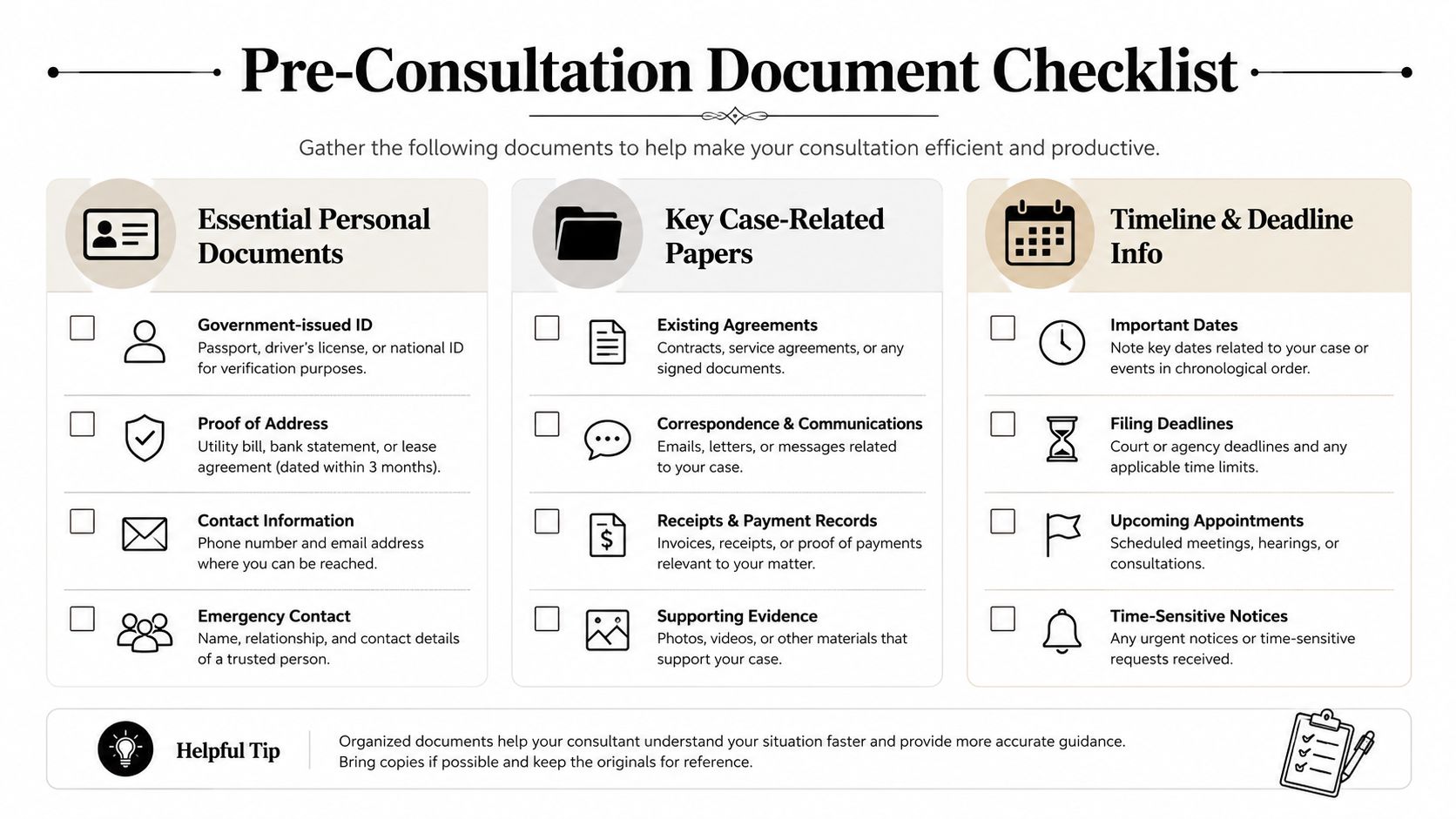
The fastest consultations I've seen all have one thing in common, the client did the sorting before the call. That doesn't mean they had every answer. It means they made it easy for the lawyer to diagnose the problem quickly.
When to Pay for a Consultation Versus Using Free Legal Resources
Don't pay for a consultation just because you're nervous. Pay for it when the issue is hard, the clock is running, or the consequences of being wrong are serious. Use free or low-cost help when you need orientation, not a full legal diagnosis.
Pay when the issue can turn on a small mistake
A paid consultation makes sense when you're facing a status expiration, a layoff, a prior denial, a removal issue, or a filing with serious consequences if it's handled badly. It also makes sense when the facts are tangled and the lawyer needs to map multiple paths before giving advice. In those situations, paying for expertise is usually cheaper than fixing a bad move later.
Free channels are still valuable for basic questions. Community clinics, nonprofit legal-aid programs, and public guidance resources can help with document gathering, general eligibility screening, and understanding the vocabulary of the process. The United Kingdom's Citizens Advice service and UK asylum or legal-aid pathways are examples of public and nonprofit channels that fill that early-stage role, and similar nonprofit immigration clinics exist in the U.S.
Use the resource that matches the stakes
If your question is “What category might I fall under?” a free resource may be enough to get you oriented. If your question is “What do I do this week to avoid falling out of status?” you need a lawyer who can look at the details and tell you what matters now.
The tradeoff is not just cost, it's quality of outcome. A cheaper conversation that leaves you uncertain can be more expensive than a paid one that gives you a clear path. That's especially true when consultations are only partially diagnostic, because the value depends on whether the lawyer can quickly interpret the facts, not just hear them.
If you're comparing whether to pay or start with a lower-cost option, this guide on legal consultation fee considerations is worth reading before you book anything.
Rule of thumb: pay when you need strategy, use free help when you mainly need orientation.
That line holds up in immigration work better than most marketing advice.
Handling Urgent Scenarios Like Layoffs and Status Expirations
Urgent cases punish vague consultations. If you lost your job, your status is close to expiring, or you just got a notice that changes your timeline, the meeting has to be about preserving options first and debating long-term strategy second.
I've seen people walk in after a layoff and spend ten minutes describing how unfair the firing felt. That's understandable, but it doesn't solve the problem. The lawyer needs the employment dates, the visa basis, the exact expiration date, and any document showing how much time is left to act. Without that, the consultation drifts.
Shift the agenda when the clock is running
In an urgent meeting, the first questions should be practical. What is the current status? What date matters most? Is there a filing, transfer, or alternative path that can be started immediately? Are there documents missing that would block same-day action?
If you have an RFE, a looming expiration, or a sudden job loss, your lawyer should spend the session on risk containment. That may mean prioritizing a filing plan over broad brainstorming. The goal is to stop the bleeding before you consider bigger strategy choices.
Bring the documents that prove urgency
For high-pressure situations, the usual folder is not enough. Add the notice of termination, the last day worked, the visa approval notice, the most recent I-94, and any deadline letter. If travel is involved, bring the itinerary and the reason for travel. If the issue involves a family change, include the marriage, divorce, or birth records that affect status options.
The more urgent the matter, the more specific your timeline needs to be. A lawyer can't tell you whether a same-day filing is realistic if they don't know which date triggers the risk. That's why a consultation in a crisis should feel tight and tactical, not broad and exploratory.

When the facts are ready, a strong lawyer can often turn an urgent call into a concrete filing path. When the facts are scattered, even a good lawyer is stuck giving cautious advice.
Evaluating the Lawyer and Deciding on Next Steps After the Session
The consultation doesn't end when the call ends. You still need to judge whether the lawyer understood your case. A polished website means nothing if the advice was generic, the pricing stayed fuzzy, or the lawyer never explained the reasoning behind the recommendation.
Look for specific experience, not broad claims
A good sign is hearing a lawyer connect your facts to a similar matter they've handled before, without pretending your case is identical to someone else's. You want a clear explanation of why one path makes sense and why another path is weaker. You also want candid discussion of risk, not a promise that “everything will be fine.”
If you need a checklist for this decision, use the questions in this hiring guide and compare the answers against what you heard in the consultation.
Watch for the wrong signals
Be wary if the lawyer dodges fee questions, can't explain the next step in plain English, or pushes you to retain them immediately without showing their work. Vague timelines are another bad sign. So is a consultation that feels like a sales call dressed up as legal advice.
Green lights are easier to spot than people think. The lawyer should name the issue, outline the options, tell you what evidence matters, and explain what happens if you do nothing. If you leave with that level of clarity, the meeting earned its fee.
If you're comparing more than one lawyer, use the same facts with each one. That way, you're comparing judgment, not just personality. Community Q&A can help you sanity-check the answers, but it shouldn't replace the legal analysis for important decisions.
Finding and Booking the Right Immigration Lawyer Quickly
The fastest way to waste time is to browse random firm pages and hope one of them happens to fit. A better approach is to look for verified credentials, actual case experience, upfront pricing, and real availability. That's the difference between shopping and matching.
A structured marketplace can reduce the usual mess. HeyAtty is built to help users describe the issue, compare profiles, check consultation pricing and availability, and book a relevant lawyer without starting from zero. If your practice area is unclear, a guided intake flow is the right way to narrow the field before you spend time on outreach.
When you're reviewing profiles, don't stop at “immigration law.” Look for evidence that the lawyer has handled matters like yours, whether that means layoffs, status problems, family filings, or removal issues. The right profile should tell you why the match makes sense, not just claim generic experience.
Use the consultation as the first serious filter, not the last. If the lawyer can explain your situation clearly and give you a realistic next move, you're in the right place. If not, keep looking until you find someone who can.
If you're trying to make sense of an immigration problem before the clock runs out, start with a marketplace that helps you match the issue to the right lawyer fast. Visit HeyAtty to compare vetted immigration professionals, review pricing and availability, and book a consultation that fits the facts you're dealing with.