
What Is a Lawyer Consultation? a Practical Guide
What Is a Lawyer Consultation. Understand what a lawyer consultation is, how it works, and how to prepare. Learn the difference between a chat and a real legal
A lawyer consultation is a brief, limited conversation in which you explain a legal problem, receive preliminary information, and decide whether the lawyer and practice area fit your needs. It may be unpaid, yet it can still create professional obligations, including duties involving confidentiality and conflicts.
You may be searching because a letter arrived from an employer, a business deal went wrong, an immigration deadline is approaching, or a family dispute has become impossible to manage alone. You know something matters, but you may not know what kind of lawyer to contact, what documents to gather, or whether a short meeting will help at all.
That uncertainty is normal. A consultation isn't automatically a full legal case, and it isn't merely a casual sales call. It's a structured checkpoint between a confusing situation and a sensible next step. The lawyer listens, gathers enough information to assess the matter, checks whether a conflict exists, considers whether the issue falls within their competence, and explains what they can and can't do.
The most useful question isn't only, “How much does a consultation cost?” It's also, “What will I receive, what must I disclose, and what happens afterward?” Understanding those details helps you protect your privacy, choose the right professional, and use limited meeting time well.
Table of Contents
- Understanding the Lawyer Consultation
- The Hidden Ethics of a Consultation
- Consultation Formats Compared
- Preparing for Your Legal Meeting
- Navigating Fees and Lawyer Selection
- Why Early Legal Guidance Matters
- Conclusion and Next Steps
Understanding the Lawyer Consultation
Suppose Maya receives a notice from her employer and suspects she may have been treated unfairly. She searches for an employment lawyer, finds someone with an impressive profile, and books a meeting. During the call, she explains what happened, names her employer, mentions the relevant dates, and asks whether she has a claim.
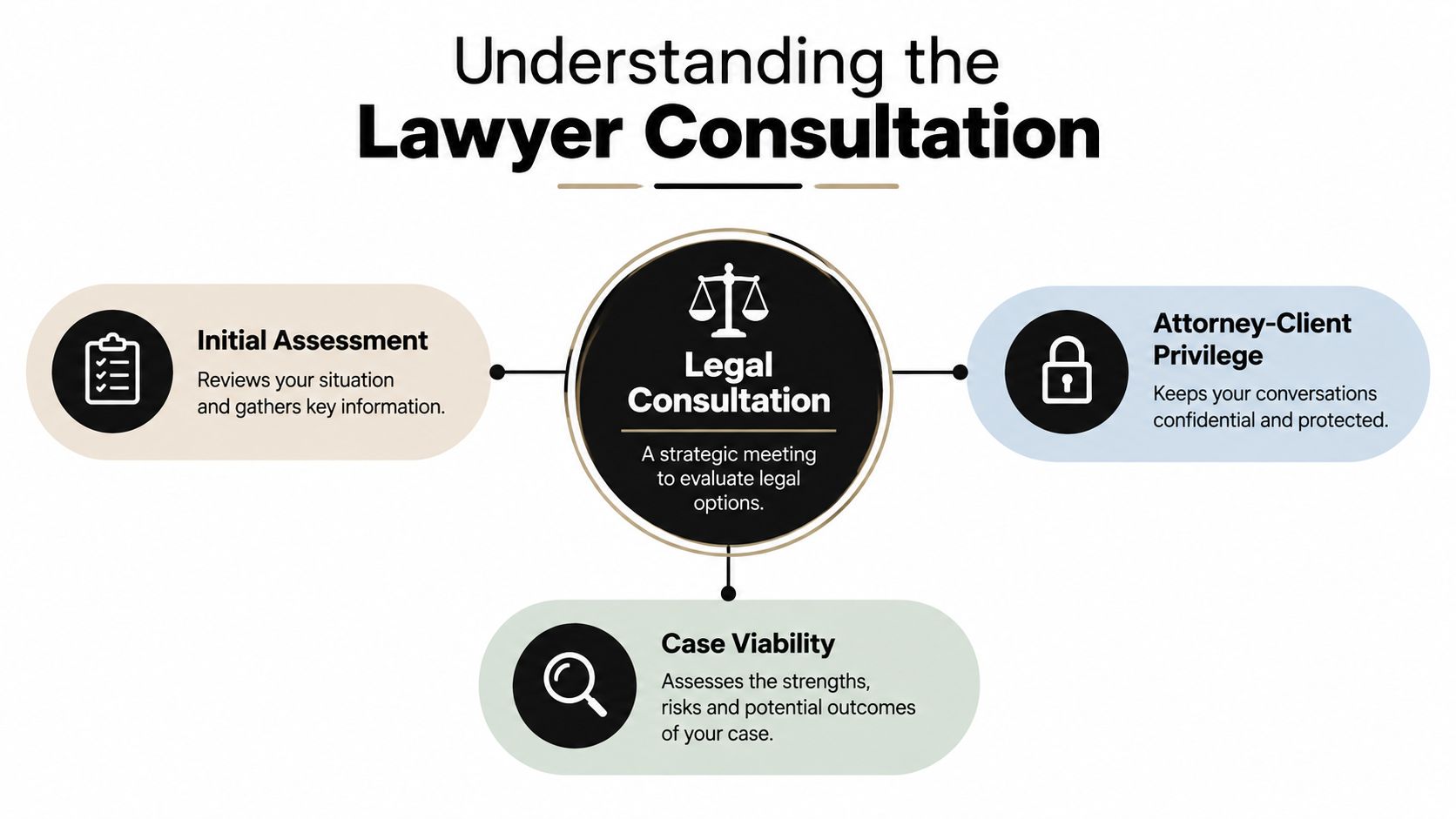
That conversation is the consultation. It gives Maya a chance to receive preliminary legal information and gives the lawyer enough context to determine whether the matter belongs within the lawyer's practice, whether a conflict may exist, and whether the lawyer has the competence and capacity to assist. The consultation may lead to representation, limited-scope work, a referral, or a decision not to proceed.
A consultation is therefore best understood as a pre-engagement assessment, not as a promise that the lawyer will take the case. Professional guidance describes a process involving initial contact, screening, an interview, acceptance or declination, and written confirmation. The practical result should be a clear next step, not an ambiguous conversation that leaves both sides guessing. Louisiana State Bar guidance on initial consultations explains why screening and confirmation matter before legal work begins.
What the first meeting can accomplish
A productive meeting may help you:
- Identify the legal issue: Separate a contract dispute from a consumer complaint, employment concern, immigration matter, or another type of problem.
- Clarify urgency: Identify filing deadlines, scheduled hearings, notices, or other events that affect timing.
- Test professional fit: Learn whether the lawyer handles your jurisdiction and the specific kind of matter you have.
- Choose an appropriate level of help: Decide whether you need general information, limited advice, document assistance, negotiation, or ongoing representation.
You shouldn't expect every consultation to include document drafting, court representation, or a prediction of the final outcome. The lawyer may need more facts, evidence, or jurisdiction-specific research before offering a recommendation. A good meeting makes those limits visible and records what happens next.
The Hidden Ethics of a Consultation
You tell a lawyer the opposing party's name, describe sensitive facts, and leave without signing a retainer. The conversation may still carry professional consequences. A prospective client can share confidential information, while the lawyer may acquire duties before formal representation begins.
North Carolina's Formal Ethics Opinion 14 explains that a client-lawyer relationship may arise during an initial consultation even when no fee is paid. It also states that, for professional-conduct purposes, the relationship is unequivocally established when a lawyer charges for a service and the fee is paid, even if that service is limited. The North Carolina State Bar opinion was issued in 2006 and published in 2007.
This does not automatically create full representation for every future legal issue. It means the meeting should be treated as a professional service, not casual conversation. Depending on the circumstances, the lawyer may need to address confidentiality, conflicts, competence, fees, the limits of the work, and whether accepting the matter is appropriate.
Why your first disclosure matters
Suppose Lawyer A learns the identity of the person opposing you and hears sensitive details. That person later asks the same firm for help. The information you provided may affect whether the firm can represent them. Lawyers therefore often request names, organizations, jurisdictions, and a short description before inviting a detailed account.
Use progressive disclosure, much like giving a receptionist enough information to route a call before discussing the whole matter:
- Supply the names and other details needed for an initial conflict check.
- Describe the issue briefly, leaving out unnecessary strategy or sensitive evidence.
- Ask how the lawyer treats information shared during consultations.
- Wait for instructions before sending highly sensitive documents.
- Confirm whether the meeting is informational, limited-scope advice, or intake for ongoing representation.
Practical rule: “Free” does not mean “without professional consequences,” and paying for a consultation does not automatically cover every legal issue you may have.
The fee also pays for a defined service, not a guaranteed result. The lawyer may assess the facts, evidence, deadlines, jurisdiction, and uncertainty, then explain what can reasonably be concluded. Before leaving, ask whether the lawyer accepts or declines the matter, what work the fee covers, what limitations apply, and what you should do next.
Consultation Formats Compared
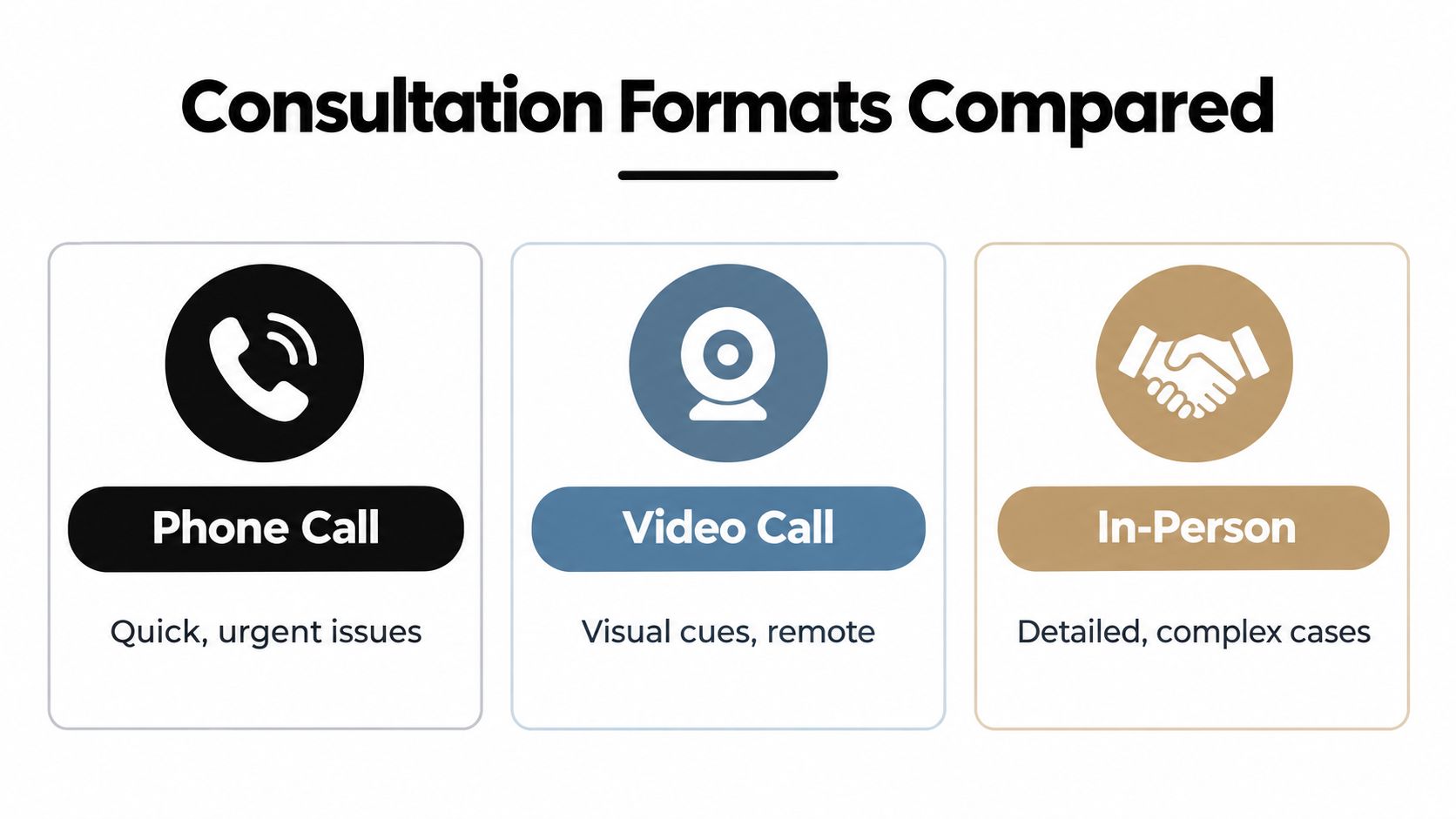
The right format depends on the problem, the documents involved, your privacy needs, and how quickly you need an initial assessment. A short phone call may be enough to identify the practice area and urgency. A video meeting can make it easier to discuss documents and establish a personal connection. An in-person meeting may suit a complex matter where you want to review a substantial file with the lawyer beside you.
| Format | Often useful for | Main limitation |
|---|---|---|
| Phone call | Quick screening, urgent questions, and situations where internet access or privacy is limited | You may not be able to review documents easily or observe visual cues |
| Video call | Remote consultations, document discussion, and a meeting where facial expressions or screen sharing help | You still need a private space and reliable technology |
| In-person meeting | Complex matters, detailed document review, and people who communicate better face to face | Travel, scheduling, and office access may create extra friction |
Matching the format to the situation
A phone call can work well when you need to know whether a deadline requires immediate action or whether the lawyer handles your type of matter. It may be less suitable when your question depends on a contract, notice, medical record, business document, or immigration form.
Video meetings often provide a useful middle ground. You can join from home, share a document when appropriate, and still have a direct conversation. The online lawyer consultation guide can help you think through what remote preparation involves.
In-person meetings may feel more reassuring when the facts are complicated or you need help organizing a physical file. They don't automatically produce better advice, however. The lawyer's relevant experience, preparation, jurisdiction, and clear explanation of scope matter more than the room in which you speak.
Before booking, ask whether the format includes document review, how documents should be transmitted, whether the meeting is recorded, and what privacy precautions apply. Choose the format that lets you explain the issue accurately and safely.
Preparing for Your Legal Meeting
A lawyer can assess a matter faster when the story has a clear shape. You don't need to write a legal brief. You need a reliable account of what happened, who was involved, what has already occurred, and what outcome you want.
Start with a short chronology. Use dates where you know them, and label uncertain details instead of guessing. For example, write that you signed an agreement, received a notice, sent a response, attended a meeting, or discovered a problem. Keep each entry focused on an event and its effect.

Build a useful preparation file
Organize your material around decisions the lawyer may need to make:
- People and entities: List your name, the other parties, employers, businesses, agencies, witnesses, and anyone who sent or received important communications.
- Location and authority: Note where the events happened, where the parties are located, and which court, agency, employer, or government office is involved.
- Deadlines and procedural status: Record hearing dates, response dates, expiration dates, pending applications, and anything already filed.
- Documents: Gather contracts, notices, letters, emails, messages, forms, invoices, photographs, and prior legal correspondence that directly relates to the issue.
- Desired result: Explain what you want, such as negotiating an agreement, responding to a notice, protecting a business, applying for status, recovering money, or deciding whether formal action is worthwhile.
Don't send every document just because you have it. Begin with the items most relevant to the question, and ask the lawyer how to share anything sensitive. A concise issue summary is often safer and more useful than a large, unorganized upload.
Questions that improve the meeting
Write your questions before the appointment. Ask what the lawyer thinks the immediate risk is, what facts could change the assessment, which documents matter most, what options exist, and what work would be included if you proceed.
For a business owner, a business lawyer consultation may involve ownership documents, customer agreements, employment questions, or a threatened dispute. Separate those topics rather than presenting the entire history of the company at once. Clear priorities help the lawyer spend the limited meeting time on the issue that needs attention first.
End by asking for the status of the matter. Is the lawyer accepting it, declining it, requesting more information, or referring you elsewhere? Ask for any agreed scope and follow-up in writing.
Navigating Fees and Lawyer Selection
A consultation fee buys a defined professional service, not automatic representation. One lawyer may provide a time-limited discussion and preliminary guidance. Another may include a capped review of selected documents or a written follow-up. Unless the lawyer states otherwise, the fee usually excludes open-ended research, drafting, negotiations, and court work.
The price makes more sense once you identify the billing method. A fixed fee covers a stated service at a stated price. An hourly arrangement charges for time under the lawyer's billing terms. A broader engagement may use another method. A 2025 survey of recent legal-services users found that 57% reported a fixed-fee billing method, while 10% reported being charged hourly. The survey covered legal services generally, not consultation fees, so The Legal Services Consumer Panel report is not a price guide for your meeting.
Before booking, ask for a plain description of what you will receive:
- Included time: How long is the meeting?
- Document limits: Will the lawyer review documents, and how many?
- Follow-up: Will you receive an email, action list, or written summary?
- Future credit: Can the fee be applied to later representation?
- Scope: Is this general information, limited advice, or an intake for ongoing work?
- Payment terms: When is payment due, and what happens if you cancel?
Selection depends on more than a practice-area label. An immigration lawyer may handle matters unlike yours. A business lawyer may advise companies without experience in your agreement or dispute. Ask about the lawyer's experience with your specific fact pattern, jurisdiction, and procedural stage. For example, a lawyer who regularly drafts contracts may not be the right choice for a dispute already headed toward court.
Use legal consultation fee guidance to frame practical questions about cost and scope. Compare professional profiles, availability, consultation pricing, and described services. Confirm those details directly before sharing sensitive information. A clear fee agreement protects both sides by showing where the conversation ends and paid legal work begins.
Why Early Legal Guidance Matters
A deadline is approaching, a letter has arrived, and the facts still feel scattered. You may hesitate to contact a lawyer because you do not have a complete case file or expect professional help to be unaffordable. Waiting can leave you uncertain about deadlines, evidence, jurisdiction, and whether the problem requires action. A consultation gives you a structured starting point, even if full representation is not suitable.
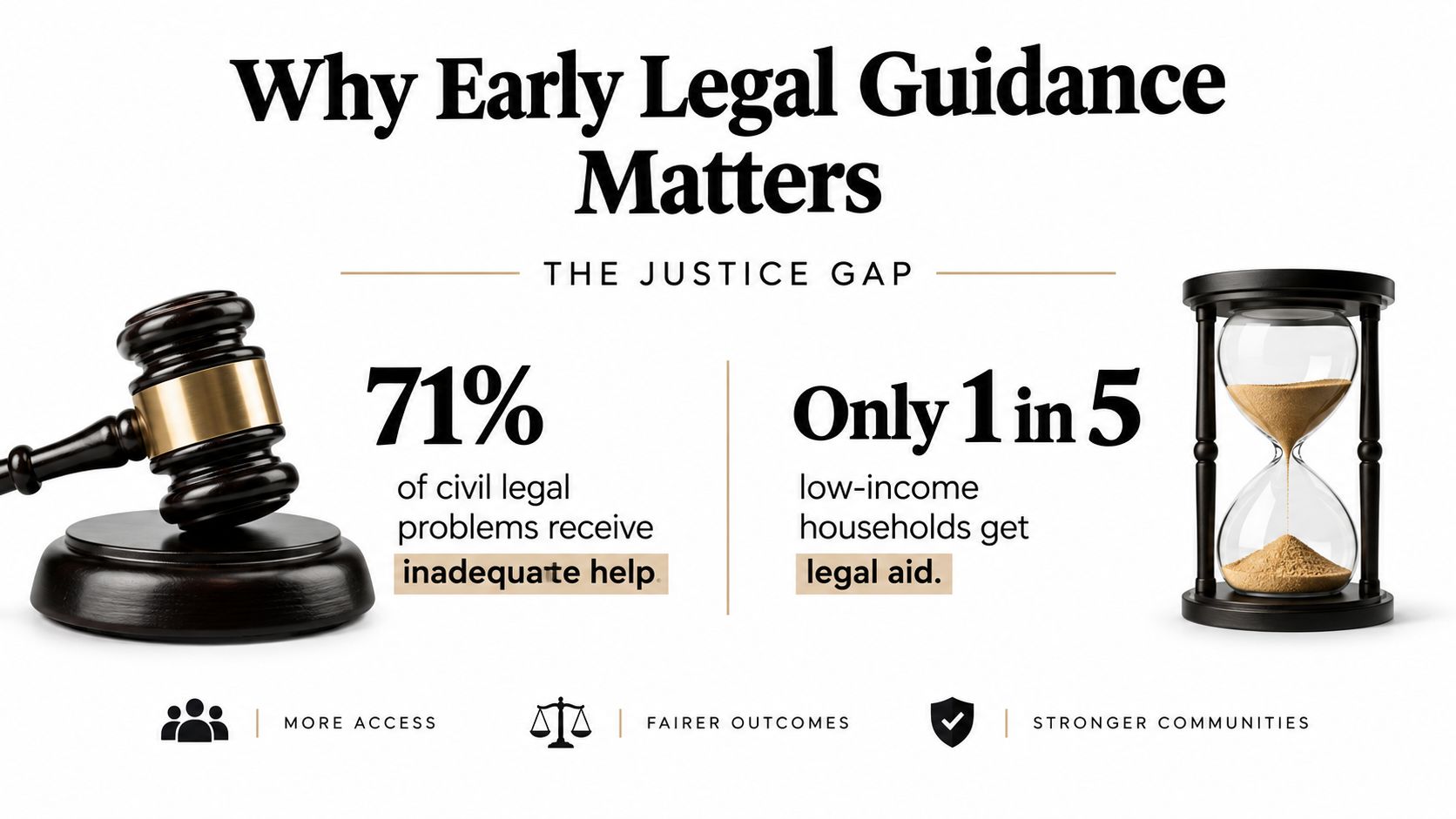
Access remains difficult. The Legal Services Corporation's 2022 Justice Gap study found that 74% of low-income U.S. households experienced at least one civil legal problem during the preceding year, while 92% of their substantial civil legal problems received no or inadequate legal help. The Legal Services Corporation's Justice Gap research also reported that low-income people brought an estimated 1.9 million problems to LSC-funded legal-aid organizations in 2021. Organizations could not provide any or enough help for approximately 1.4 million of those problems.
Consultation as triage
Earlier research by the same organization found that low-income households sought legal help for only 20% of their civil legal problems. It also found that only 28% to 38% of an estimated 1.7 million problems presented to LSC-funded organizations were expected to receive enough assistance to fully address the legal need. These figures do not mean a consultation solves the access problem. They show why an early assessment can matter when full representation is unavailable or unaffordable.
A lawyer may help you sort the situation into four practical questions:
- The immediate issue: Which legal problem needs attention first?
- The critical facts: Which details and documents could change the assessment?
- The available path: Would self-help, limited advice, legal aid, negotiation, or full representation fit the situation?
- The next contact: If this lawyer cannot help, which specialty or service should you contact?
The goal is an informed decision, not pressure to hire. Early guidance may help prevent a missed step, an unsuitable booking, or detailed disclosure to a lawyer who cannot handle the matter. It can also clarify what the consultation has produced, such as limited advice, a referral, or a defined next action, so the conversation does not remain merely informal.
Conclusion and Next Steps
A lawyer consultation is a limited, structured professional conversation. You explain the problem, receive preliminary information, and determine whether the lawyer, practice area, format, and proposed scope fit your needs. The meeting may not become full representation, but it can still matter ethically, especially when you disclose confidential facts or pay for a defined service.
Prepare a short chronology, identify the parties, note deadlines, gather focused documents, and write down the outcome you want. Before sharing detailed information, understand how the lawyer handles conflicts and confidentiality. Before paying, confirm the duration, document limits, follow-up, scope, cancellation terms, and whether the fee applies to later work.
Choose the meeting format that supports accurate communication. A phone call may suit quick triage, while video or an in-person meeting may make document discussion easier. No format replaces careful matching. Look for relevant experience with your specific situation, not only a broad label such as immigration, employment, family, business, or real estate.
The conversation should finish with a decision or a clearly documented next step. You may receive limited advice, a request for more information, a referral, an engagement proposal, or a declination. Each outcome is more useful than leaving without knowing what the lawyer understood, what remains uncertain, and who is responsible for the next action.
You don't need to solve the entire legal problem before asking for help. You need enough organized information to begin a careful assessment and enough questions to understand what the meeting includes.
HeyAtty lets you describe your legal situation, compare vetted professional profiles with stated availability and consultation pricing, and book a consultation when you find a suitable fit. Visit HeyAtty to organize your starting point and take the next step with clearer expectations.