
Business Lawyer Consultation: How to Prepare and What to Ask
A practical business lawyer consultation guide. Learn what to bring, which questions to ask, and how to get real value from your first meeting with counsel.
You've got a calendar invite, a contract sitting in your inbox, and no clear idea what the first call is supposed to accomplish. You're hoping the lawyer will ask the right questions, spot the danger, explain the cost, and tell you what to do next. That's a lot to expect from a conversation you haven't prepared for.
I learned this the expensive way. After three bad consultations, I stopped treating the first call as a polite introduction. A business lawyer consultation is a triage meeting. You're testing the lawyer's fit, separating urgent legal risk from ordinary business judgment, and exposing the likely cost before you sign a retainer. The better you prepare, the less time you spend paying someone to discover basic facts you already know.
Table of Contents
- You Just Booked a Business Lawyer Consultation Now What
- Why Most Business Owners Actually Pick Up the Phone
- Preparing Your Documents and One-Page Brief Before the Call
- Questions That Reveal Whether the Lawyer Fits Your Business
- Flat Fee Hourly or Free What Each Option Really Gets You
- Making the Consultation Itself Work Harder
- Turning One Call Into a Legal Plan You Can Use
You Just Booked a Business Lawyer Consultation Now What
The booking confirmation isn't the end of your search. It starts a short preparation window.
A founder I know once entered a first call with only a sentence in an email, “I need help with a partnership agreement.” The lawyer spent most of the meeting asking who owned what, whether anything had been signed, and what the co-founder actually wanted. By the end, the founder had paid for background questions and received a recommendation to schedule another call after sending documents.
That outcome is common because owners confuse access with progress. They book the call, wait for the lawyer to lead, and then try to reconstruct months of business decisions from memory. The lawyer may be capable, but the meeting becomes an expensive fact-finding exercise instead of a decision meeting.
Small-business legal demand is substantial but often fails to become professional help. In the UK, the Legal Services Board found that 32% of small businesses had at least one legal issue in the previous 12 months, while only 25% of those businesses used professional help. The same findings estimated 12% had an unmet legal need and only 3% had a met legal need, as reported in this summary of the Legal Services Board findings. The lesson is practical. Recognizing a problem isn't enough. You need a low-friction path from concern to a useful first conversation.
Treat the call as a pressure test
Your first call should answer four questions:
- What kind of legal problem do I have?
- What information or documents does the lawyer need?
- What could this cost if the matter expands?
- Can this lawyer give advice in a way I can use?
The usual triggers are a contract, a business structure or equity question, a dispute, or a compliance concern. Each needs different preparation. Walking in cold wastes billable minutes, encourages vague advice, and makes it harder to compare lawyers fairly.
Practical rule: Don't book a generic business lawyer. Book someone for the specific problem that is creating risk right now.
Why Most Business Owners Actually Pick Up the Phone
A “business lawyer” is a broad label, not a qualification for every business problem. The lawyer who excels at defending a lawsuit may not be the right person to structure founder equity. A corporate lawyer who prepares formation documents may not be the right person to respond to a cease-and-desist letter.
Start by naming the trigger. That decision determines what the lawyer should review, which questions deserve most of the call, and whether a fixed or hourly arrangement makes sense.
Four common triggers
Contract review or negotiation usually starts with a vendor agreement, master services agreement, lease, customer terms, or licensing deal. Bring the complete document, negotiation history, and your preferred commercial outcome. Ask where liability, termination, payment, intellectual property, confidentiality, and dispute terms expose you. A lawyer who only summarizes clauses without connecting them to how your business operates isn't giving you enough.
Entity formation and equity questions arise when you're incorporating, adding a co-founder, issuing shares, or deciding how control should work. The consultation should address ownership, decision rights, vesting, intellectual property assignment, tax coordination, and what happens if someone leaves. Don't hire a litigator for a straightforward formation matter unless the ownership dispute already exists.
A dispute or demand letter changes the priority immediately. Bring the letter, relevant contract, timeline, messages, invoices, and any response deadline. Ask what must happen first, what you shouldn't say, and which options exist short of litigation. A lawyer should distinguish preserving your position from escalating the conflict.
Regulatory or compliance exposure often appears when you hire employees, collect customer data, enter a regulated market, or change how you sell. Bring policies, forms, workflows, and the specific activity you're worried about. Ask which obligations are immediate, which are lower priority, and what evidence would show that you're managing the risk responsibly.
| Trigger | Documents to Bring | Priority Question | Best-Fit Fee |
|---|---|---|---|
| Contract review | Agreement, redlines, emails, business terms | Which clauses create unacceptable operational or financial risk? | Fixed fee for defined review, hourly for negotiation |
| Formation or equity | Formation records, operating agreement, cap table, founder notes | Who controls decisions, owns work product, and bears future risk? | Flat fee for defined setup, hourly for complex restructuring |
| Dispute or demand letter | Letter, contract, timeline, correspondence, records | What must we do now to preserve options and avoid making matters worse? | Hourly or staged litigation strategy |
| Compliance exposure | Policies, forms, process notes, relevant communications | Which exposure is urgent, and what practical control should we implement first? | Fixed audit scope or hourly advice |
The NFIB's survey of small employers found that 65% had sought advice or other assistance from a lawyer in the previous year, rising to 78% over the previous three years. It also found that 55% of those who consulted a lawyer asked for legal documents to be prepared, with debtor and creditor relations at 21% and contracts at 19% among the most frequent topics, according to the survey report on small-business legal needs. Consultation isn't a ceremonial first step. It often determines whether the next deliverable is a document, a negotiation plan, or a dispute response.
Identify your trigger before you book. That one decision keeps the consultation focused and makes the fee easier to predict.
Preparing Your Documents and One-Page Brief Before the Call
You don't need a legal background to prepare well. You need an organized folder and a blunt description of what you want.
Gather the materials in categories. Start with formation paperwork, including articles, an operating agreement, shareholder documents, and the current cap table if ownership is relevant. Add the triggering document, such as the contract, demand letter, proposed term sheet, employment document, or regulator communication. Include prior correspondence, especially messages that explain what was promised or negotiated.
If money is involved, prepare a simple financial snapshot. That might include unpaid invoices, the amount in dispute, expected contract value, or the cost of delaying a decision. Finally, list the current stakeholders. Include owners, directors, employees, contractors, customers, vendors, and anyone else whose conduct or approval affects the matter.
Write the one-page brief
Put these five fields at the top of the folder:
- Situation in two sentences. State what happened and when.
- Desired outcome. Say what you want the lawyer to help you achieve.
- Main concern. Identify the risk you're most worried about.
- Decisions already made. Separate settled choices from open questions.
- Budget ceiling. State what you can authorize now and what requires approval.
This brief prevents the lawyer from spending the first part of the call extracting basic facts. It also lets you compare two consultations without relying on your memory of who sounded more confident.
Don't send a 40-page contract dump with no explanation. A lawyer can't tell which clauses matter to you, what commercial promises were made outside the document, or whether you want a risk report, a redline, or negotiation support. Context is part of the instruction.
If your matter involves formation or startup ownership, this business formation attorney guide can help you identify the information a lawyer will need before the call.
Screenshot checklist
- Create one folder: Put the brief, triggering document, correspondence, and financial material together.
- Rename files clearly: Use names such as
Vendor-MSA-current,Demand-letter-date, andCap-table-current. - Mark priority pages: Flag the clauses or paragraphs you need explained.
- Write your outcome: Describe the result you want in ordinary business language.
- Set your limit: Decide what you can spend before the lawyer recommends more work.
Questions That Reveal Whether the Lawyer Fits Your Business
The first call isn't a deposition. You're not trying to prove that you deserve representation. You're deciding whether this lawyer understands your problem, explains tradeoffs clearly, and works in a way your business can afford.
Ask questions in three buckets. A vague answer in any one bucket should lower your confidence, even if the lawyer has impressive credentials.
Legal competence
Ask:
- Have you handled matters like this recently? You want relevant experience, not just a broad practice-area label.
- What facts would change your initial view? A thoughtful lawyer will identify missing information instead of pretending the answer is already obvious.
- Which jurisdiction or industry rules could affect the advice? This matters when your customers, employees, assets, or counterparties cross borders or regulated sectors.
- What are the realistic options? You should hear more than “send it over” or “we can fight this.”
- What would success look like for this matter? The answer should connect legal work to your business objective.
If the lawyer immediately gives a confident conclusion without asking about the contract, timeline, parties, or desired outcome, slow the conversation down. Confidence isn't analysis.
Cost clarity
Ask:
- What exactly is included in the initial scope?
- What billing increment do you use, and who bills time to the matter?
- What event would cause the fee or scope to change?
The Legal Ombudsman advises that clients shouldn't be surprised by a bill, that cost terms should be explained or confirmed in writing at the outset, and that the explanation should be recorded. Its transparency study found that among firms publishing prices, fixed fees were advertised by 63%, hourly rates with an hours estimate by 22%, and estimates by 19%, as described in this guidance on good costs service.
A lawyer who won't explain what causes a new invoice is giving you a pricing problem before the work starts.
Working style
Ask:
- Who will handle the work?
- What response time should I expect for urgent and routine questions?
- How do you check for conflicts before accepting the matter?
A lawyer who answers clearly gives you something usable, even if the answer isn't what you hoped to hear. Score each bucket after the call as strong, acceptable, or concerning. Your verdict should reflect competence, cost clarity, and working style together.
For a broader screening framework, use this guide on how to choose a lawyer.
Flat Fee Hourly or Free What Each Option Really Gets You
The cheapest consultation isn't automatically the best value. A free introductory call can be useful, but it usually answers whether there's a basic fit. It rarely provides detailed document analysis, a written opinion, or a complete action plan.
A paid consultation can be worth it when the decision is urgent, the document is consequential, or the wrong move could create a larger dispute. The question isn't just “What does the call cost?” Ask what decision the fee will help you make.
Match the structure to the problem
A free introductory call generally works for conflict screening, practice-area fit, and a high-level description of next steps. Don't expect the lawyer to review a long contract or solve a complex dispute in that window.
A flat-fee consultation suits a defined question. Agree in writing on the documents covered, the questions answered, the meeting length, and whether you'll receive a written summary. If the lawyer says “consultation” without defining the output, ask for the scope before paying.
An hourly intake session makes sense when you need deeper analysis, several documents reviewed, or immediate strategy. In the United States, a 2026 pricing guide places many business and contract consultations around $200 to $500, while some firms charge $0 and others charge substantially more depending on complexity and location, as described in this small-business legal concerns survey. Treat that range as orientation, not a quote.
| Structure | Typical Cost | What You Get | Best For |
|---|---|---|---|
| Free introduction | $0 | Basic fit, conflict screening, high-level direction | A simple question about whether to proceed |
| Flat-fee consultation | Agreed fixed price | Defined review and defined advice, with written output only if included | A focused contract, formation, or compliance question |
| Hourly intake | Often around $200 to $500 per consultation hour, depending on the matter and location | Deeper review and live strategic analysis | Urgent, document-heavy, or high-consequence issues |
Price is a real access barrier. The same survey material reports that 67% named cost as the primary barrier in one 2025 survey, while 75% said they avoid lawyers because of cost in another. That's why you should ask for the first-call price, scope, and likely next step before the meeting.
Use a simple rubric. Choose free when the issue is only fit. Choose flat fee when the question is narrow and the deliverable can be defined. Choose hourly when uncertainty, urgency, or document volume makes a fixed scope artificial. This guide to legal consultation fees can help you compare the structures before booking.
Making the Consultation Itself Work Harder
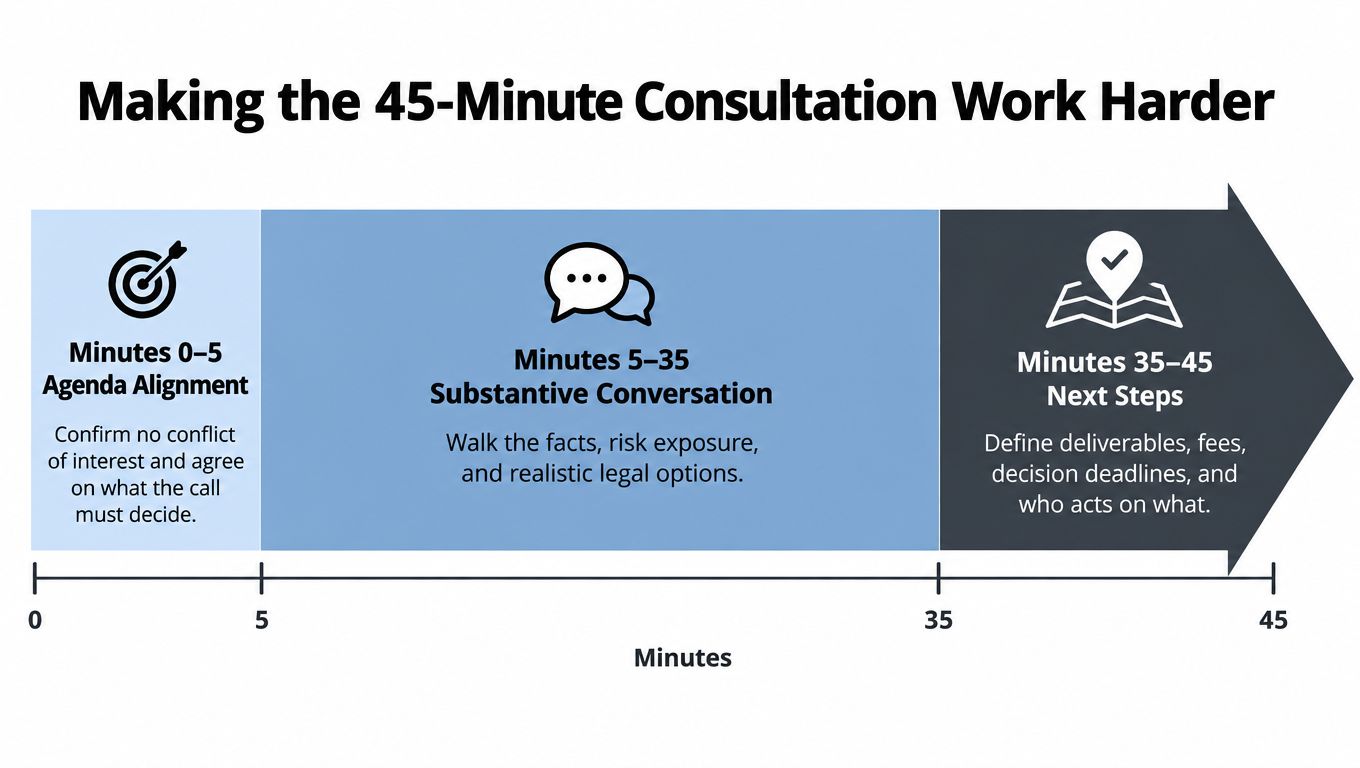
A focused consultation has three phases. Protect each one instead of allowing the conversation to drift.
The opening phase
Use the first 5 minutes to confirm there's no conflict, state the outcome you want, and agree on the agenda. Say, “By the end of this call, I need to understand my immediate risk, my realistic options, and what the next piece of work would cost.”
That sentence forces the lawyer to listen for a decision, not just a story.
The substantive phase
Use the next 30 minutes for facts, risk, and options. Refer to your one-page brief instead of retelling every email. If the lawyer starts expanding the assignment, ask, “Is that included in today's scope, or would it be separate work?” Get the answer before agreeing.
Lawyers also need to distinguish legal advice from the client's commercial choice. A practical guide to the pitfalls of giving business advice versus legal advice explains why clients may ask whether they should proceed when they need the legal structure, risks, and available options explained.
The closing phase
Reserve the final 10 minutes for action. Ask for the next deliverable, owner, deadline, fee, and information still missing. Before the call ends, say, “Please confirm the scope, fee, and next steps in writing after this call. What will that recap include?”
Don't leave with “send us everything and we'll take a look.” Leave with a defined next action.
Turning One Call Into a Legal Plan You Can Use
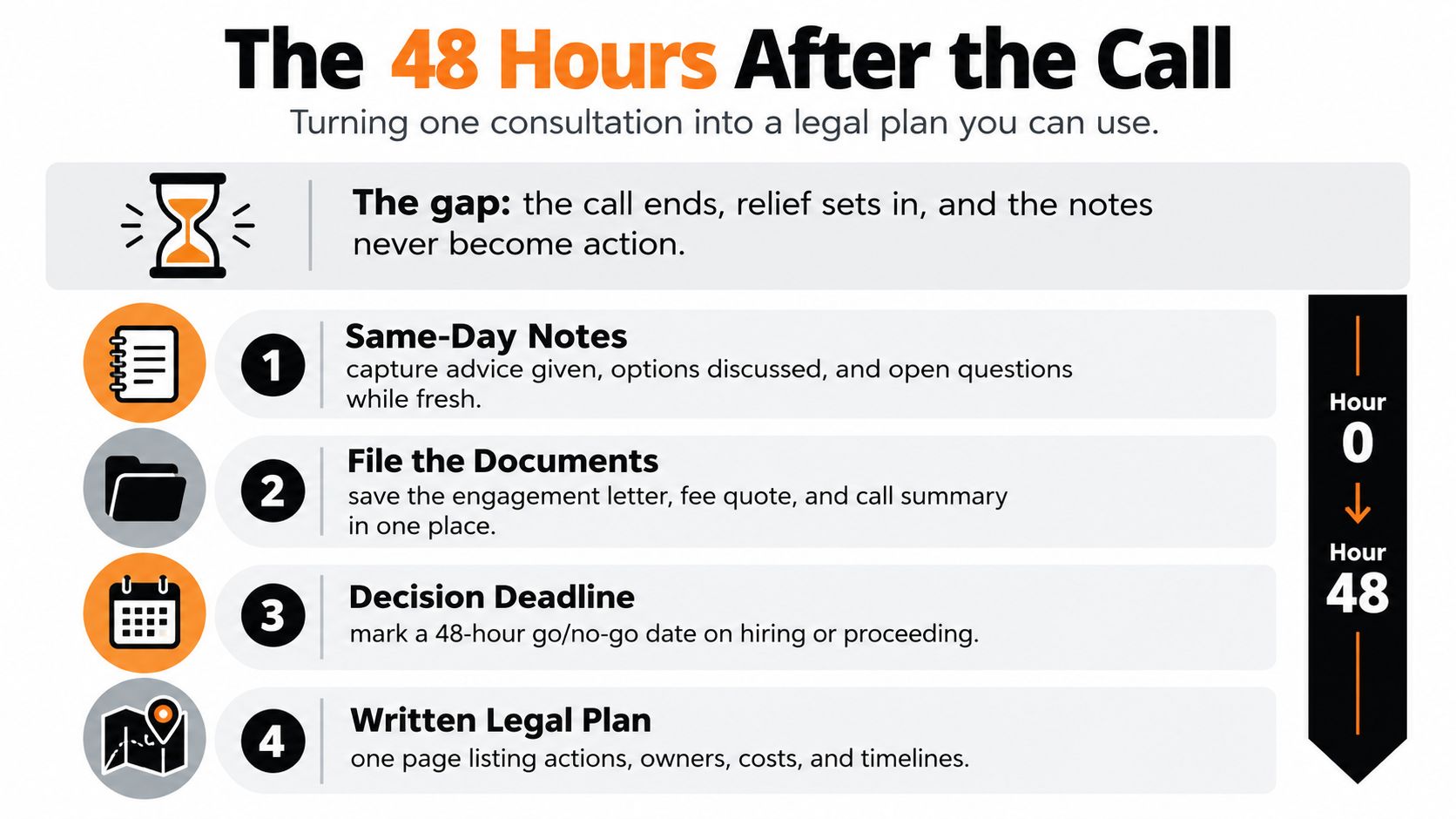
The consultation's real value appears after the call. Many owners hang up feeling reassured, then return to the same contract, dispute, or compliance gap without changing anything. Relief is not a legal plan.
Within the first day, write down what the lawyer said while the details are fresh. Separate legal conclusions from assumptions, commercial preferences, and unanswered questions. If the lawyer explained that you have several options, list the consequences of each option in business terms.
Capture the advice
Send a short summary email. Include the facts you believe the lawyer relied on, the risks identified, the options discussed, and the action you understood you should take. Ask the lawyer to correct anything inaccurate. This creates a practical record and exposes misunderstandings before they become expensive instructions.
Request an engagement letter before substantive work begins. It should identify the client, matter, scope, responsible lawyer, billing method, expected costs, payment terms, and events that could expand the work. Cost guidance emphasizes that clients should understand billing terms at the outset, not after the first invoice arrives.
Ask the lawyer to identify the next two trigger events that should bring you back. For a contract, that might be a major redline or a refusal to accept a liability position. For a dispute, it might be a formal response deadline or a new demand. For compliance, it might be a product launch, employee onboarding, or a change in data handling.

Decide whether to continue
Continue with the lawyer when the advice is specific, the scope is written, the cost matches the decision, and the lawyer's experience fits the trigger. You don't need perfect certainty. You do need a clear next step and a communication style you can work with.
Book a second opinion when the lawyer dodges basic cost questions, recommends work without explaining the decision it supports, overlooks the documents you provided, or gives advice outside the relevant jurisdiction. A second consultation is particularly sensible when the matter affects ownership, a valuable contract, a serious demand, or a deadline you can't reverse.
Use an assignable action list
Write the plan like an operating document:
- Owner: Founder sends the current agreement and negotiation history.
- Lawyer: Review liability, termination, intellectual property, and dispute clauses.
- Finance lead: Confirm the maximum commercial concession.
- Operations lead: Identify what implementation would change if the contract is signed.
- Decision date: Choose whether to sign, negotiate, or walk away.
- Recheck date: Review the matter again after the agreed business milestone.
The lawyer's job is to explain legal risk and available protections. Your job is to make the commercial decision with that information. Keep those roles separate, and the consultation becomes much more useful.
A business lawyer consultation shouldn't end with more uncertainty than it began with. Prepare the facts, test the fit, expose the cost, and leave with written actions. That's how a short call becomes an operational legal asset instead of another vague conversation you paid to forget.
If you want to compare business lawyers by relevant practice area, profile details, pricing, availability, and booking options, visit HeyAtty and use the guided intake to describe your situation before scheduling a consultation. Bring the resulting match information, your one-page brief, and your documents to the first call so you can spend the time making a decision, not explaining why you booked it.