
How to Legally Change Name After Marriage in 2026
Learn how to legally change name after marriage in 2026, from getting a certified certificate to updating your SSN, ID, and accounts without delays.

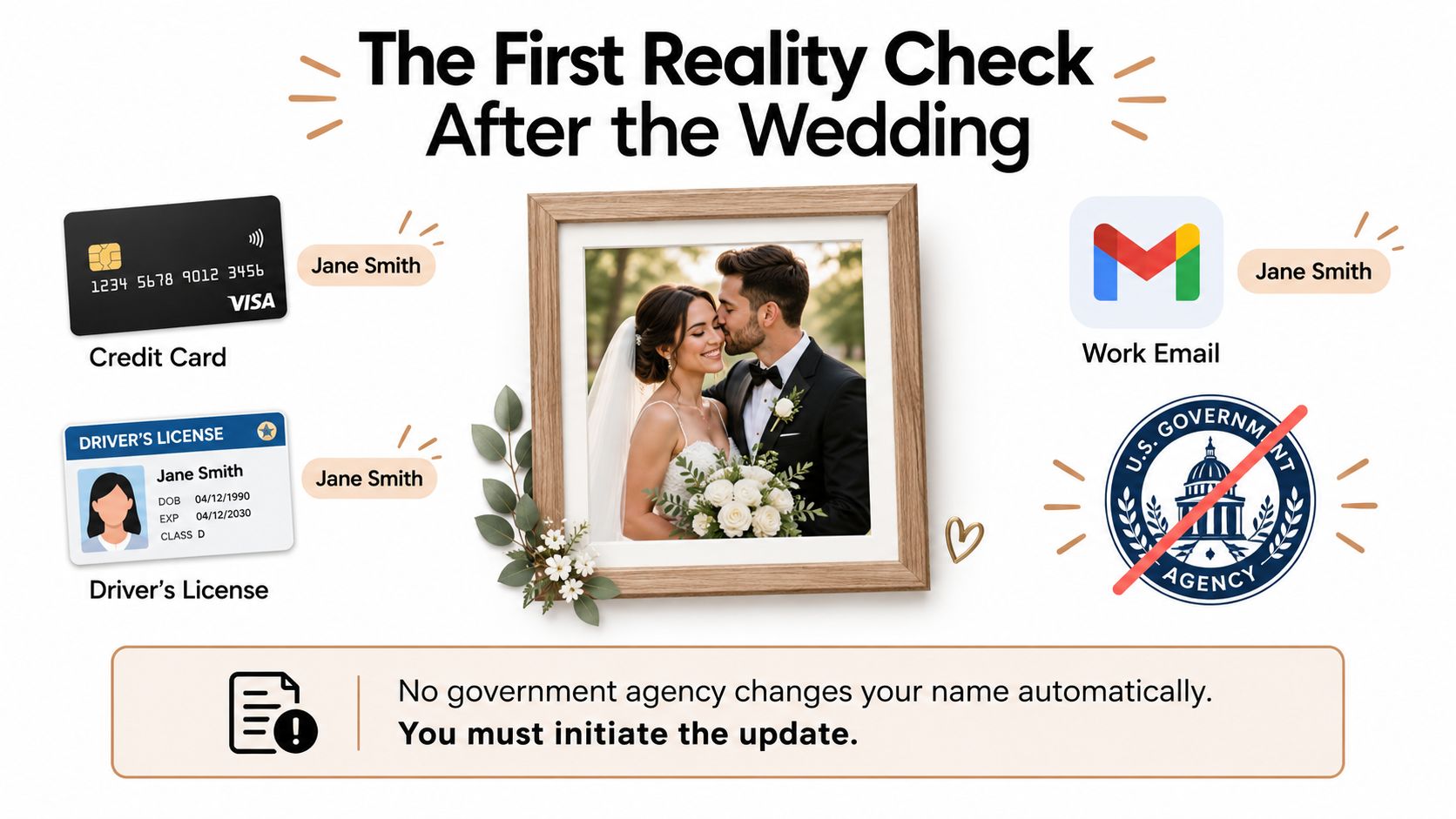
The wedding photos are edited, the thank-you notes are underway, and your credit card still carries your old surname. Your driver's license, work email, bank account, and passport may all tell the same story. You got married, but none of those systems received the news automatically.
If you want to legally change your name after marriage, treat the task as a document project, not a single form. In the United States, marriage itself generally doesn't require anyone to change surnames, and no state mandates that a person take a spouse's name upon marriage. Modern law is permissive, although the custom of adopting a husband's surname remains common. Legal scholarship from the University of Chicago Law Review traces both the historical default and the modern right to retain a name.
The practical rule is simple: obtain the certified marriage certificate, use it to establish the new name with the right agencies, then update every private record separately. The certificate is your master key, but it doesn't turn every lock for you.
Table of Contents
- The First Reality Check After the Wedding
- What a Marriage Certificate Can and Cannot Do
- The Document-Led Sequence That Actually Works
- Updating Social Security and Your State ID Step by Step
- Updating Everything Else From Passports to Payroll
- When the Rules Change for Men, Same-Sex Couples, and Joint Surnames
- When to Hire a Lawyer and Your Final Checklist
The First Reality Check After the Wedding
The morning after the wedding, your new surname may exist on paper while every working account still shows the old one. A decorative certificate from the venue will not satisfy an agency. Request a certified copy issued by the government office that recorded the marriage. It proves the marriage and supports an eligible name change, but it does not update Social Security, a driver's license, a bank profile, payroll, or an airline account.
The federal government's USA.gov name-change guidance states the practical rule: contact each agency separately. Your certified certificate is evidence for each request, not a central instruction delivered to every organization that stores your identity information.
Build the project around the certificate
Decide the surname you will use before filing anything. Then create a secure folder with certified certificates, current identification, Social Security details, passport information, and a tracking sheet for every account.
Use this order:
- Secure certified proof: Request certified marriage certificates from the county or jurisdiction that recorded the marriage.
- Establish the federal record: Update Social Security before changing your state identification.
- Update identity documents: Change your driver's license or state ID, then update your passport.
- Clean up private records: Contact banks, employers, insurers, professional boards, utilities, subscriptions, and other providers.
This order keeps agencies from seeing mismatched records. It also gives you a clear fallback when a bank, DMV, or employer rejects a document because the new name has not appeared in the preceding identity system.
The certificate route usually works for one spouse taking the other's surname or adopting a conventional hyphenated form. Expect more friction if a man changes his name, both spouses create a shared surname, the couple uses a blended format, or a form assumes an opposite-sex marriage. Same-sex couples should verify that the agency accepts their marriage record and requested format. A joint new surname may require a court order rather than certificate-based processing.
If the paperwork stops being a sensible DIY task, get jurisdiction-specific advice before submitting another rejected application. Compare a targeted legal consultation with the cost of repeated filings. HeyAtty's guide to legal consultation fees can help you prepare for that conversation.
What a Marriage Certificate Can and Cannot Do
A marriage certificate can support a name change, but its authority has limits. The correct question isn't “Can I change my name after marriage?” Ask instead, “Does my chosen name fit the marriage-based options recognized where I live?”
Texas offers a useful example. Its state legal guidance on marriage name changes describes common certificate-based options that can include taking a spouse's surname, hyphenating surnames, moving a maiden surname into the middle-name position, or dropping a middle name. Other jurisdictions use similar categories, but you must check the rule applied by your state and the agency processing the request.
A certificate normally won't create an entirely unrelated surname, change a first name, merge two surnames into a new word, or automatically change a child's surname. It also can't correct an error in the original marriage record. Those situations may require a court petition, an amended vital record, or both.
| Name Change Goal | Marriage Certificate Only | Requires Court Order |
|---|---|---|
| Take your spouse's surname | Usually accepted when the jurisdiction recognizes the marriage-based change | Sometimes needed if the record or agency doesn't support the requested format |
| Hyphenate both surnames | Often accepted when the marriage record and state rules permit it | May be needed for an unusual construction or agency dispute |
| Move a maiden surname into the middle-name position | Recognized in some state procedures, including the Texas example | Needed if the chosen format falls outside local rules |
| Drop a middle name | May be permitted under marriage-based procedures | Needed if the jurisdiction doesn't recognize the requested change |
| Create a completely new shared surname | No | Yes, in many jurisdictions |
| Change a first name | No | Yes |
| Correct an error on the marriage record | No | Requires the applicable vital-record correction process, and possibly a court order |
| Change a child's surname | No | Usually requires a separate procedure involving the child and, where applicable, the other parent |
Read the form before you file
Forms often reveal the legal boundary. If the form offers only a spouse's surname, a hyphenated combination, or a middle-name adjustment, don't force a joint invented surname into the nearest blank. That can create inconsistent records and a rejection later.
The same problem appears when a marriage certificate is valid but doesn't clearly show the name a spouse wants. The Texas State Law Library's FAQ on married name changes notes that a certificate may not be enough for a name that isn't clearly tied to the marriage record. If your choice falls outside the listed options, stop treating the task as routine paperwork and investigate the court route.
The Document-Led Sequence That Actually Works
Treat the certified marriage certificate as the master document, then build each update from the record created before it. This order reduces mismatched records and gives each agency the proof it expects.
Start with certified copies
Order certified copies from the county clerk or other issuing authority. Keep one secured at home and reserve the others for offices that require mailed documents or retain originals. A regular photocopy may fail, while mailing your only certified copy can stop the process when another agency requests the same evidence.
Build the identity chain
- Social Security Administration: Submit the marriage-based name-change request through the SSA option available to you. Online or in-person filing depends on eligibility. SSA recommends waiting at least 30 days after the marriage date before requesting a replacement card, allowing state records time to update. USA.gov explains the federal sequence and timing.
- State driver's license or ID: After SSA reflects the new name, bring the certified certificate, current identification, and every document listed by your state DMV. Check the DMV requirements before you travel.
- Passport: Update it once your core identity records match. If travel is scheduled soon, make the passport name match the airline ticket and booking exactly.
- Financial and employment records: Contact banks, credit unions, payroll departments, insurers, and other providers separately. Each organization sets its own request method and proof requirements.
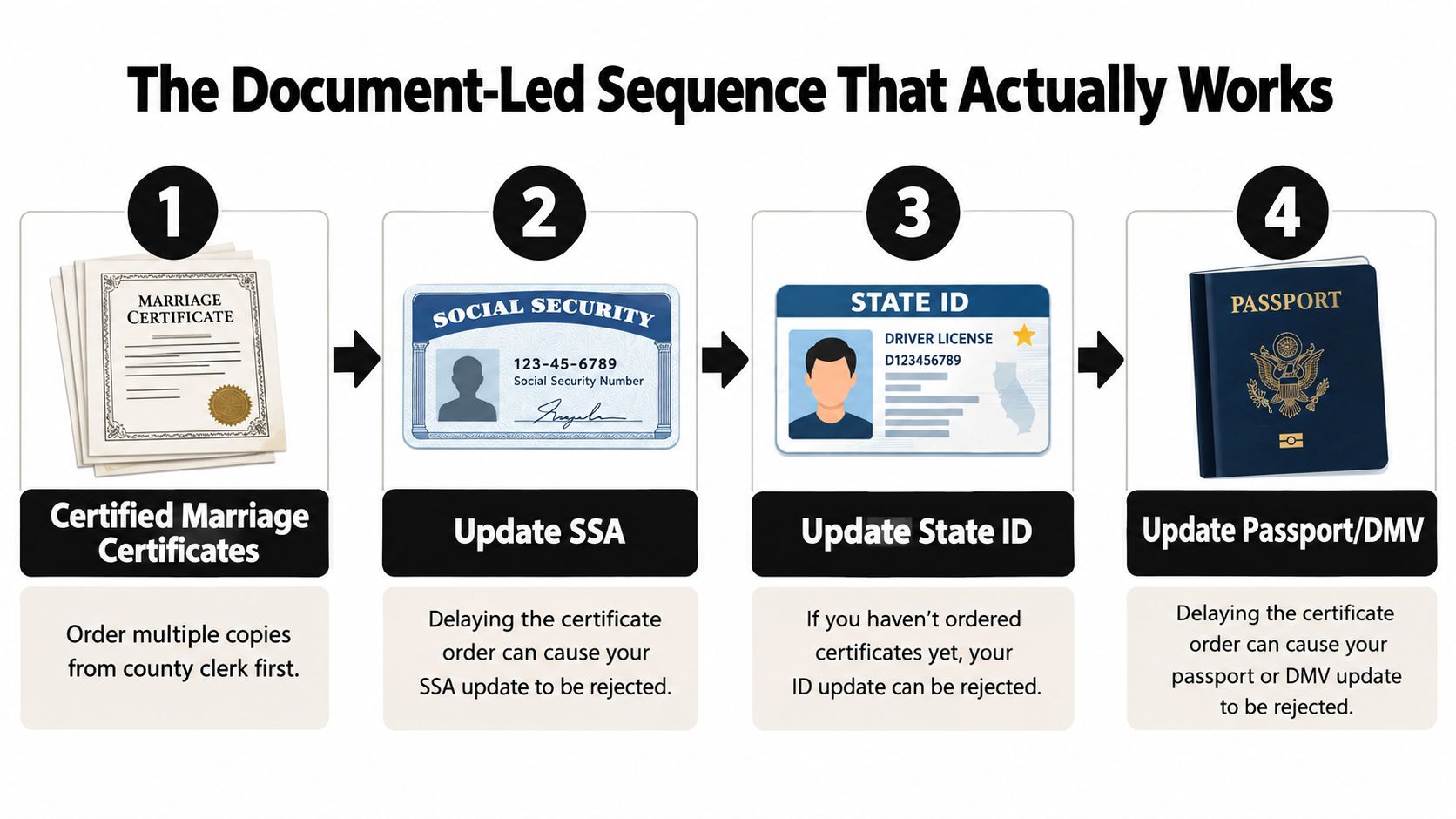
Practical rule: Do not begin with your bank for convenience. Establish the name with Social Security first, then obtain state identification that matches it.
Scan every submitted form. Record the filing date, delivery method, confirmation number, and expected response. If an agency rejects the request, those notes show which document it reviewed and help you request the exact missing requirement instead of restarting the entire chain.
Updating Social Security and Your State ID Step by Step
Social Security and your state ID form the foundation of the rest of the process. Handle them carefully, because a mismatch between these records can make later updates unnecessarily difficult.
File the Social Security request correctly
Prepare the application and supporting identity documents required by the Social Security Administration. In a standard marriage-based request, that typically means:
- Application: Complete Form SS-5 according to the SSA instructions.
- Photo identification: Use a current driver's license, passport, or state-issued identification card.
- Marriage evidence: Provide the original or a certified marriage certificate, as required by the filing method.
- Citizenship or immigration evidence: Bring the applicable proof if SSA needs to verify your status.
The SSA instructions for a replacement Social Security card should control the details, especially if your citizenship, immigration status, or identity documents require special handling. Depending on eligibility, you may file online, by mail, or in person. The online account isn't a universal shortcut, so don't assume a minor correction tool can process a full legal name change.
Your Social Security number stays the same. The requested update changes the name associated with that number and produces a replacement card. Save the receipt or confirmation because your DMV may accept evidence that the update is in progress, while other states may insist on the updated record or card.
Prepare for the DMV visit
State requirements vary, so check your DMV's official list before booking an appointment. Common requests include:
- certified marriage certificate
- current driver's license or state ID
- Social Security card or SSA confirmation
- proof of residency
- completed state application
- payment and, in some states, a new photograph or signature
Hyphens, accents, shortened names, and unusual spacing deserve special attention. Ask the DMV in advance whether it wants an affidavit or additional proof. A clerk may understand your request but still lack authority to override the system's permitted name formats.
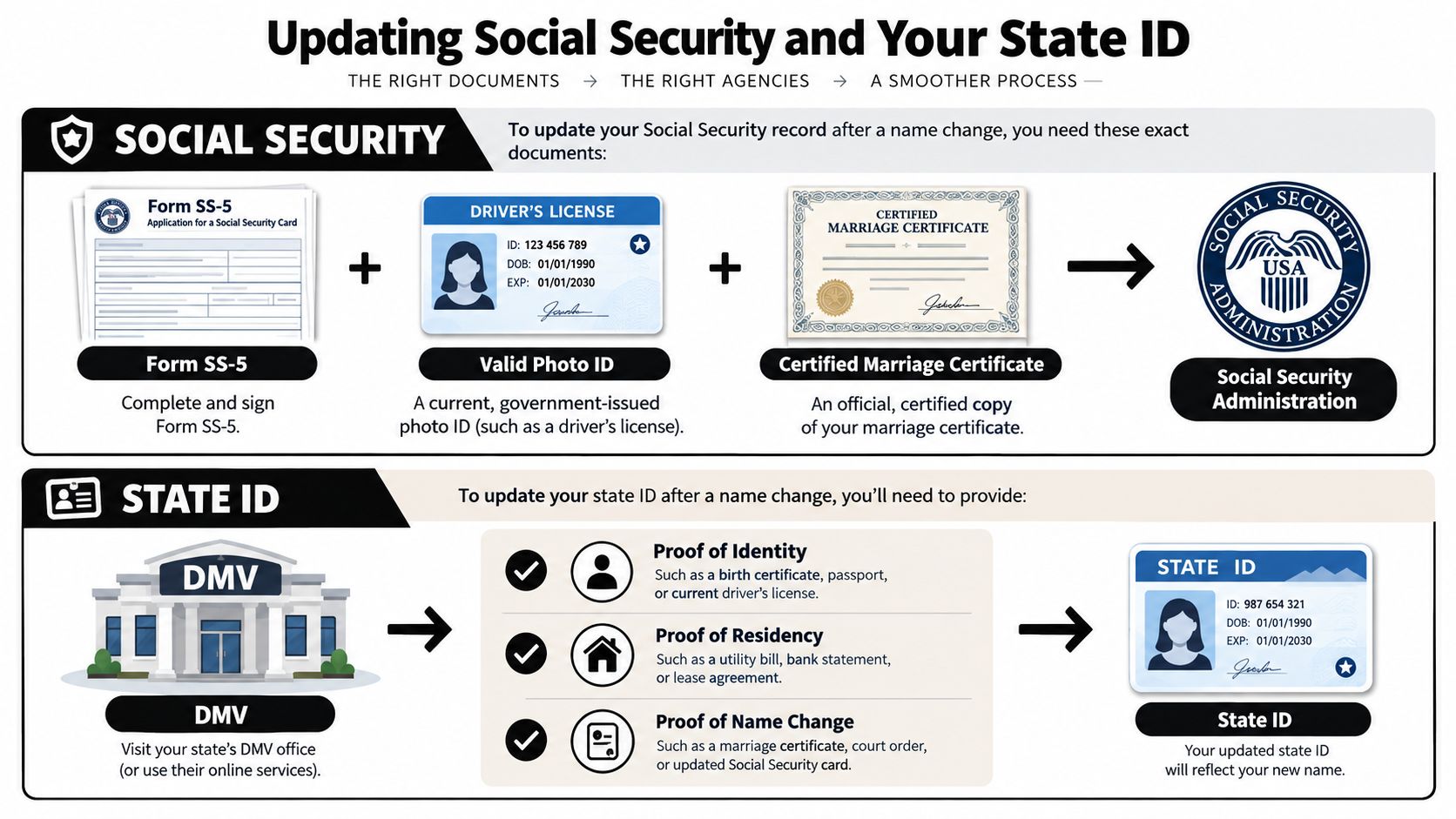
Bring originals or certified documents in a clearly labeled folder. Don't rely on a phone photograph of the certificate, and don't assume the DMV can retrieve your SSA update while you're standing at the counter.
Updating Everything Else From Passports to Payroll
Once your federal and state identity records agree, work through the private systems that affect travel, money, employment, insurance, and access. Use a spreadsheet with columns for institution, contact method, documents sent, submission date, confirmation, and completion date.
| Record to Update | Document Required | Estimated Timeline |
|---|---|---|
| U.S. passport | Passport form, current passport, certified marriage certificate, and required photo or supporting documents | Depends on the form and current processing |
| Bank or credit union | Updated state ID and, when requested, certified marriage certificate | Depends on the institution |
| Credit cards | Issuer-specific request, often updated ID or marriage evidence | Depends on the issuer |
| Employer and payroll | HR name-change form and any requested identity or tax documentation | Depends on the employer's payroll cycle |
| Voter registration | State election form or online registration request | Depends on state processing |
| Insurance policies | Updated identity information and policy details | Depends on the carrier |
| Professional licenses | Board-specific application and supporting name-change proof | Depends on the licensing board |
Handle travel before convenience accounts
For a passport, use the U.S. Department of State's instructions for the form that matches your situation. The correct route can depend on when the passport was issued, whether it can be renewed, and whether an in-person application is required. If your honeymoon ticket uses your former name, don't change the passport name before confirming that the travel documents will match.
Banks and credit unions often want an updated photo ID, and some request the certified certificate as well. Ask for replacement debit cards, checks, and account statements where needed. Credit cards may use a separate process for each issuer, so call the number on the card rather than assuming your bank's branch can change every related account.
Don't forget the records that cause later friction
Tell HR and payroll, then review your tax and benefits records for consistency. Update health, auto, life, renters, and homeowners insurance, along with professional licenses and vehicle registration.
Voter registration, medical providers, pharmacies, utilities, leases, retirement accounts, beneficiaries, airline profiles, TSA PreCheck, Global Entry, memberships, subscriptions, email, and social accounts belong on the same tracker. You don't have to finish every item in one afternoon. A controlled sequence is better than rushing, losing a document, or overlooking a beneficiary designation.
When the Rules Change for Men, Same-Sex Couples, and Joint Surnames
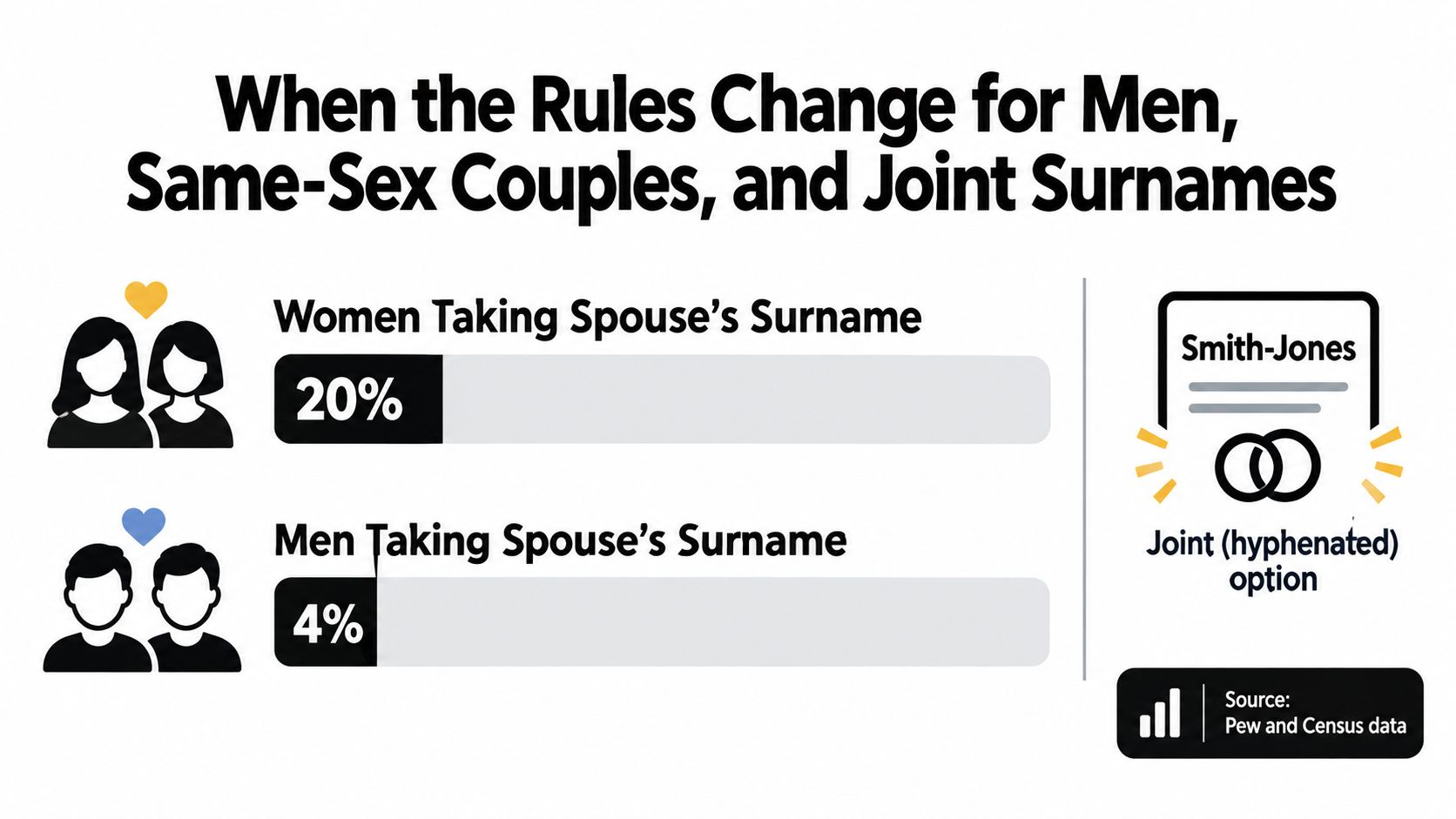
The familiar “wife takes husband's name” workflow is common, but it isn't the legal shape of every marriage. Pew Research Center reporting from 2023 found that nearly 4 in 5 women in U.S. heterosexual marriages had taken their husband's last name, while 92% of men in those marriages kept their own. The broader pattern is documented in Pew's reporting on marriage and names.
That social pattern affects clerk expectations and software design. A man asking to take his wife's surname may encounter a form that assumes the opposite direction. A same-sex couple may find that a local office's legacy instructions were written for a different family structure. The certificate proves the marriage, but it doesn't guarantee that every agency has built a clean path for the requested name.
Hyphenation can be routine when both names are used in the format authorized by state law. A blended surname, a newly invented shared name, or a surname created by combining parts of both names is a different legal question. A University of California Law Review analysis of sex-based name-change rules describes why marriage-based changes can still produce unequal practical results across jurisdictions.
Use a decision rule, not wishful thinking
- One spouse takes the other spouse's surname: Start with the certified certificate and the standard SSA-to-DMV sequence.
- One spouse hyphenates: Confirm the precise spelling, spacing, and hyphen placement accepted by the state and each agency.
- Both spouses adopt a new shared surname: Expect a court petition in many jurisdictions.
- A spouse changes a first name or creates an unrelated surname: Treat it as a court-order matter from the start.
- A same-sex couple faces inconsistent instructions: Ask the agency for its written requirements and consider legal advice before filing.
If the certificate lists a name that doesn't match the name you intend to use, don't improvise at the DMV. For immigration-related complications, a consultation with an immigration lawyer may be relevant, and HeyAtty's immigration lawyer consultation guide explains how to prepare for that kind of legal conversation.
When to Hire a Lawyer and Your Final Checklist
Most straightforward certificate-based changes don't need a lawyer. Hire one when the requested name falls outside the ordinary marriage options, when an agency rejects a valid certificate without explaining the legal basis, or when another legal issue could affect identity records.
Red flags include immigration-status questions, a contested divorce, a prior bankruptcy, a felony record, a child-related name dispute, or a mismatch in vital records. These issues don't automatically prevent a name change, but they make a casual DIY filing riskier. A lawyer can identify the correct petition, explain publication or notice requirements if applicable, and prevent you from submitting inconsistent versions of the same name.
Use a legal marketplace or direct referral service only after checking what the professional handles. HeyAtty's guide to choosing the right kind of lawyer is useful when you know you need help but aren't sure whether the matter belongs with a family, immigration, civil, or another specialist.
Finish with a controlled checklist
Print this list and mark each item only after you receive confirmation:
- Certified marriage certificate: Secure the official copies before filing.
- Social Security: Submit the request and save the confirmation.
- State ID: Update the driver's license or identification card.
- Passport: File the correct update or renewal application.
- Employer and payroll: Give HR the requested paperwork.
- Banks and credit unions: Update deposit, loan, card, and investment records.
- Voter registration: Change the election record through the authorized state channel.
- Insurance: Notify health, auto, life, renters, and homeowners carriers.
- Professional records: Update licenses, credentials, and memberships.
- Beneficiaries: Review retirement, insurance, and estate documents.
Don't pay for a court petition when your name fits the ordinary certificate route. Don't force a court-level change into a routine DMV form either. When the desired name is new, blended, first-name based, or repeatedly rejected, get a qualified legal review before sending another application.
HeyAtty helps you describe your name-change situation, compare vetted legal professionals, review availability and pricing, and book a consultation when the marriage certificate isn't enough. Visit HeyAtty to find an appropriate legal starting point and get the paperwork moving.