
How to Find an Immigration Lawyer for Marriage
Learn how to find the right immigration lawyer for marriage cases. Compare vetted profiles, verify case experience, and book consultations quickly on HeyAtty.

You're sitting at the kitchen table with a marriage certificate, a folder of screenshots, and a dozen browser tabs open. Your spouse is abroad, or already in the United States with an uncertain immigration history. Every article says “marriage-based green card,” but none answers the question that matters most: which lawyer has handled a case that looks like yours?
That's the right question. “Family immigration” is too broad a label to guide a serious hiring decision. A capable immigration lawyer for marriage should understand your procedural route, your relationship evidence, your admissibility risks, and the practical complications created by distance, separate finances, prior status problems, or a nontraditional courtship.
Marriage is a major part of the U.S. family-based immigration system. Spouses of U.S. citizens are immediate relatives, so their immigrant visas aren't subject to the annual numerical limits that apply to many family-preference categories, as explained in the USCIS Policy Manual's family-based immigration guidance. That classification matters, but it doesn't make the case automatic. The wrong filing route or a poorly explained history can still create serious delays, requests for evidence, or denial risks.
Table of Contents
- Mapping Your Specific Immigration Pathway
- Proving a Bona Fide Marriage Beyond Standard Evidence
- Vetting Attorney Experience and Case History
- Using HeyAtty to Compare and Book Vetted Counsel
- Understanding Legal Fees and Spotting Red Flags
- Preparing for Your First Legal Consultation
Mapping Your Specific Immigration Pathway
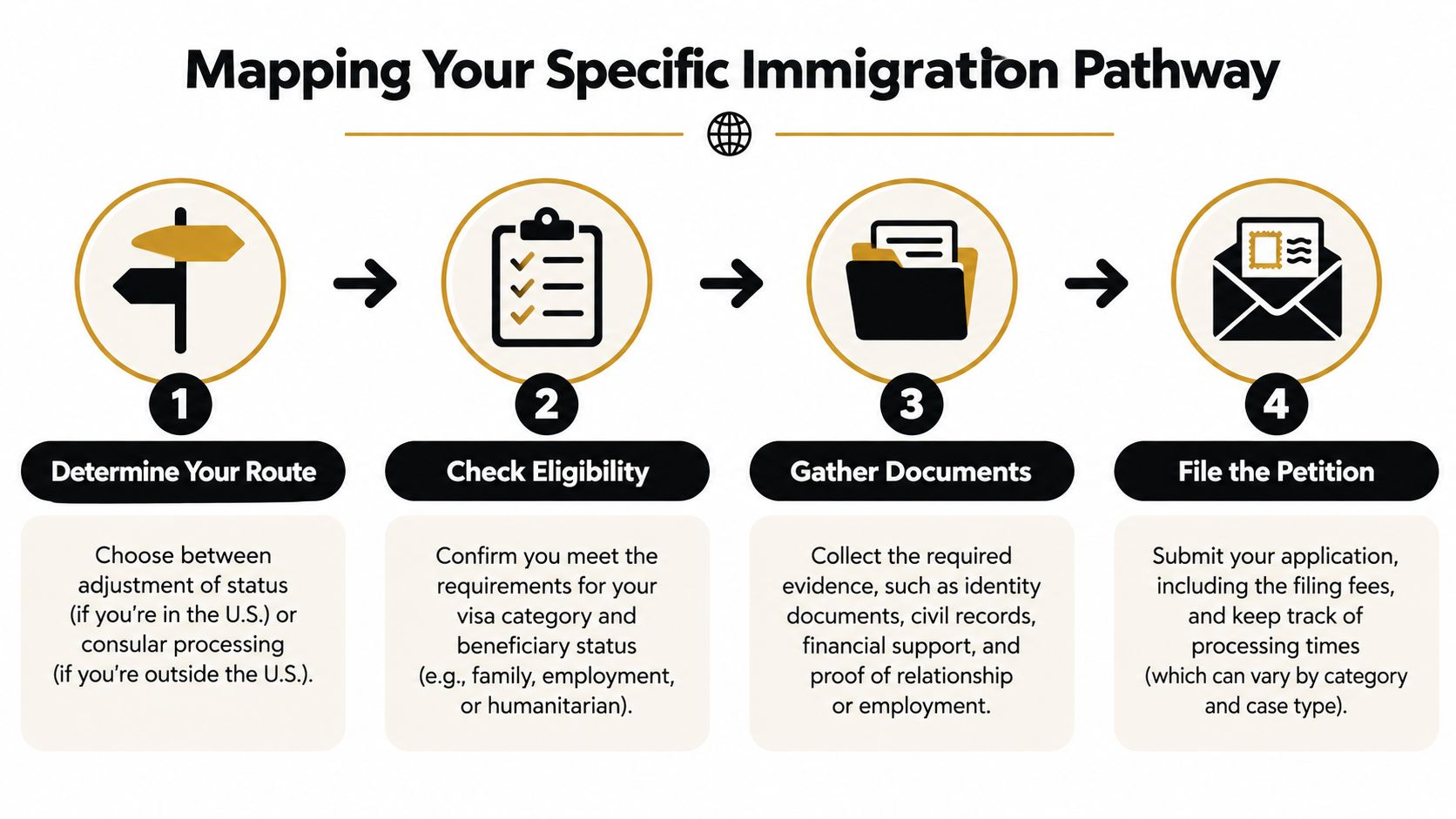
Before comparing attorneys, identify the legal route that fits your facts. A lawyer who mainly handles adjustment of status may be a poor choice for a consular case involving a prior overstay, removal history, or admissibility concern. You are hiring counsel for a specific sequence of filings, interviews, and decisions, not for a generic packet of forms.
Start with the foreign spouse's location. If the immigrant spouse is in the United States and may qualify to apply from inside the country, adjustment of status may be available. If the spouse is abroad, consular processing is generally the relevant framework. If you are engaged rather than married, a U.S. citizen petitioner may consider the fiancé(e) route, followed by marriage and a later residence application.
The route changes the legal work
The selected route determines what the attorney must investigate and what you can do while the case is pending. Bring clear answers about your location, current status, lawful entry, prior marriages, need to work or travel, and the petitioner's immigration status. These facts should shape which lawyer you contact, especially if your marriage involves long-distance living, separate finances, or earlier status problems.
A fiancé(e) case is not just a faster spouse case. USCIS-derived reporting cited by Newsweek's coverage of marriage-based green-card processing shows a 7.7-month median processing time for Form I-129F fiancé(e) petitions in fiscal year 2025, compared with 8.5 months in fiscal year 2024 and 13.9 months in fiscal year 2023. The same report shows immediate-relative Form I-130 processing reaching 14.4 months, up from 11.7 months in fiscal year 2024. These figures cover petition processing, not the complete green-card timeline.
Use that distinction when interviewing counsel. Ask whether the attorney handles the full route or only the initial petition. Ask how they address work authorization, travel permission, lawful status, evidence requests, and cases that remain pending after filing. Request examples involving your actual complication, such as spouses who lived apart or maintained independent finances. Years in practice mean little if the lawyer cannot show relevant case experience.
Status determines the risk profile
Marriage to a U.S. citizen and marriage to a lawful permanent resident follow different rules. Your first consultation should identify the applicable family category, whether an immigrant visa is immediately available, and whether current wait times affect the strategy. Current I-130 processing times are published at USCIS processing times.
You should leave the first call knowing which category applies and what facts could require a different filing plan. If the lawyer offers one timeline without asking where the beneficiary lives, whether you are already married, and what happened during earlier U.S. visits, keep looking. A structured intake through HeyAtty can help you compare attorneys by relevant case history instead of sorting through broad directory labels.
Proving a Bona Fide Marriage Beyond Standard Evidence
A marriage certificate proves that a legal marriage exists. It doesn't, by itself, prove that you entered the marriage in good faith for the purposes of immigration law. USCIS evaluates the relationship as a whole, and that requires evidence that fits your real life rather than a stock checklist copied from an online article.
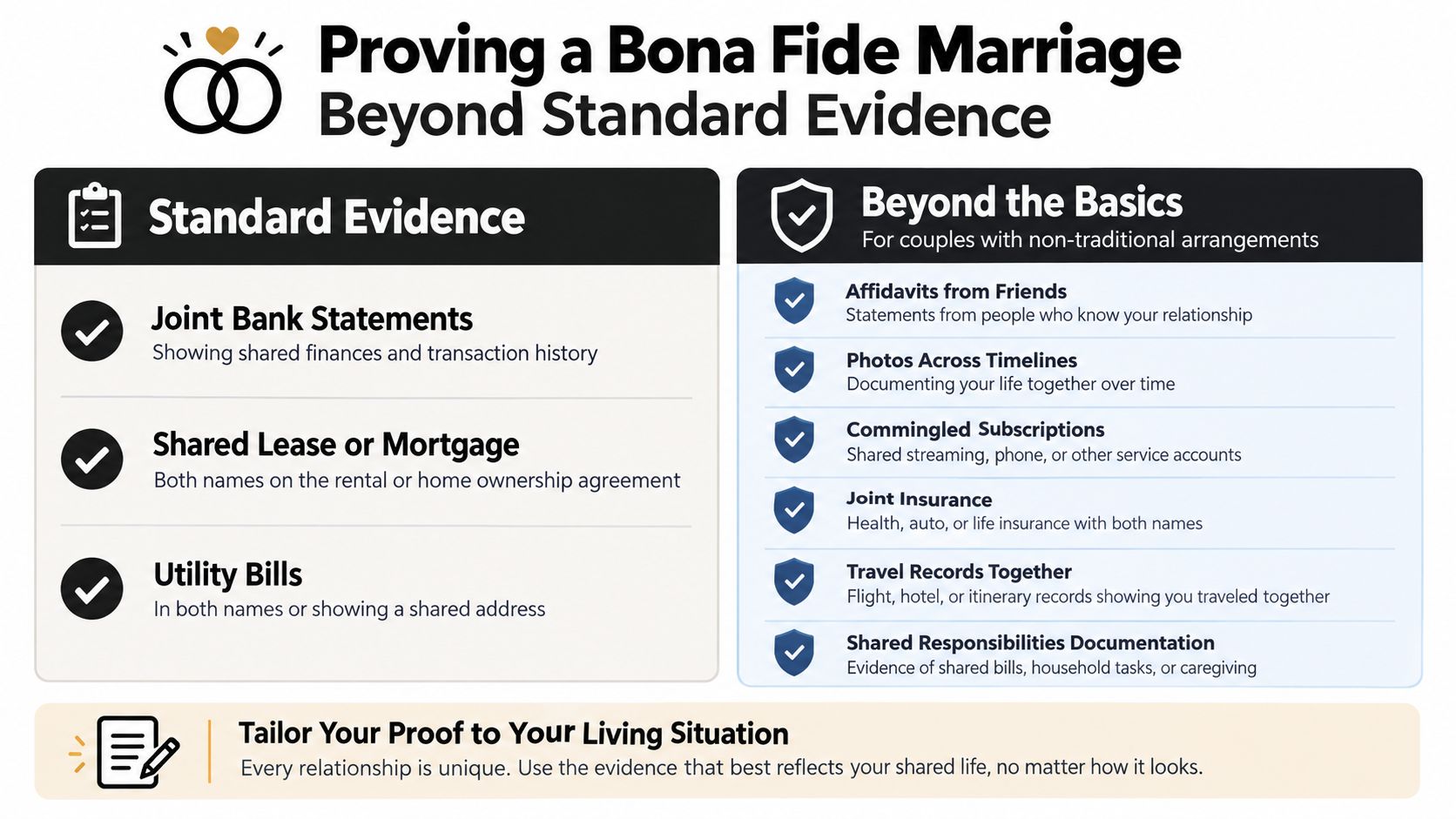
The conventional list includes joint leases, bank accounts, utility bills, insurance, tax records, photographs, and children's birth certificates. Those records can help, but they don't exist in every genuine marriage. Couples may live apart because of work, keep finances separate for cultural or safety reasons, marry recently, or build their relationship through international travel and online communication.
Consistency beats volume
The strongest file tells one coherent story. Dates, addresses, travel, names, employment, prior marital history, and major relationship events should line up across the forms and supporting records. A large collection of documents with unexplained contradictions can create more trouble than a smaller file that accurately explains why you lived separately or maintained independent accounts.
USCIS guidance recognizes a broad, fact-specific record. Possible evidence includes joint property, a shared lease, combined financial records, children's birth certificates, and affidavits from people who know the relationship. It also cautions that the absence of one evidence category doesn't automatically establish fraud, because officers must evaluate the full record and interview testimony. The USCIS testimony on marriage fraud and fiancé(e) cases describes the importance of bona fide marriage analysis, interviews, and document reliability.
Your lawyer should build an evidence matrix, not just request “everything you have.” For each important fact, identify the primary record, supporting records, and any explanation needed.
- Long-distance marriage: Use travel records, communication history, photographs across the relationship timeline, and statements from people who understand the relationship.
- Separate finances: Explain the arrangement directly and use shared responsibilities, insurance, subscriptions, transfers, or other reliable records that reflect how you actually support one another.
- Recent marriage: Show the relationship before the wedding. A newly issued marriage certificate needs context, not panic.
- International or online relationship: Organize visits, messages, calls, family recognition, and plans that demonstrate continuity without manufacturing intimacy.
Practical rule: Never add a document merely because an internet checklist says you should. Add it because it proves a specific fact and fits the timeline.
During consultation, ask the attorney to describe a comparable fact pattern they've handled. Don't ask for confidential client details. Ask how they would document “married but never cohabited” or “separate finances,” what weaknesses they would disclose, and how they would prepare both spouses for a joint or separate USCIS interview.
Vetting Attorney Experience and Case History
“Ten years of immigration experience” tells you almost nothing about whether an attorney can handle your case. Someone may have spent that time on employment petitions, naturalization, or routine family filings while rarely touching prior removal, misrepresentation, criminal history, or unusual marriage evidence.
Treat the consultation as an interview. You're testing the lawyer's method, not trying to impress them with a perfectly organized story.
Ask questions that expose real experience
Start with your hardest fact, not the easiest one. Say that you live apart, that one spouse has no joint bank account, that the beneficiary previously overstayed, or that a former marriage ended outside the United States. Then ask:
- Have you handled this exact procedural route? Ask whether the lawyer regularly represents adjustment, consular, or fiancé(e) cases.
- Have you handled this fact pattern? Request examples involving long-distance marriages, separate finances, prior status violations, or admissibility concerns.
- What would you investigate first? A strong answer identifies missing facts instead of jumping straight to forms.
- How would you build the evidence file? Look for a timeline, evidence matrix, exhibit index, and reconciliation of names, addresses, and dates.
- How do you prepare for interviews? The answer should involve truthful preparation and consistency, not memorized scripts.
- What would make you recommend a waiver, litigation strategy, or separate specialist? A lawyer who acknowledges limits is safer than one who promises a routine filing.
USCIS may interview spouses together or separately. Missing evidence, questionable bona fides, and unreliable documentation after a Request for Evidence or Notice of Intent to Deny can increase scrutiny. Your counsel should explain how the file will respond to those risks before filing, not after an officer identifies them.
Examine the work product
Ask what you'll receive before submission. A careful practice should review every form, compare the forms against source documents, flag inconsistencies, and preserve a complete copy of the filing. The exhibit index should make it easy to locate the record supporting each material fact.
Use this guide to choosing a lawyer as a practical prompt for evaluating communication, credentials, scope, and fit. Don't let a polished website substitute for answers about your actual pathway.
A lawyer who cannot explain why your evidence is persuasive, incomplete, or potentially confusing isn't ready to protect you at interview.
Using HeyAtty to Compare and Book Vetted Counsel
The traditional search is inefficient. You type “marriage immigration lawyer,” open a series of firm websites, repeat your story to intake staff, and discover that consultation pricing or availability isn't listed. Then you start over because the first attorney handles only domestic adjustment cases while your spouse is abroad.
A structured marketplace gives you a different starting point. Instead of filtering only by a broad practice label, describe the facts that determine legal fit: spouse abroad, adjustment after lawful entry, prior overstay, long-distance relationship, separate finances, or a concern about admissibility.
Compare the search methods
| Traditional search | Structured comparison |
|---|---|
| Broad practice-area labels | Case details tied to immigration experience |
| Repeated phone calls | Guided intake before outreach |
| Pricing may be unclear | Consultation pricing can be reviewed in the profile |
| Availability appears late | Available booking times are visible earlier |
| Long lists of firms | A smaller set of relevant matches |
| Evidence fit is hard to assess | Case-history details can guide your questions |
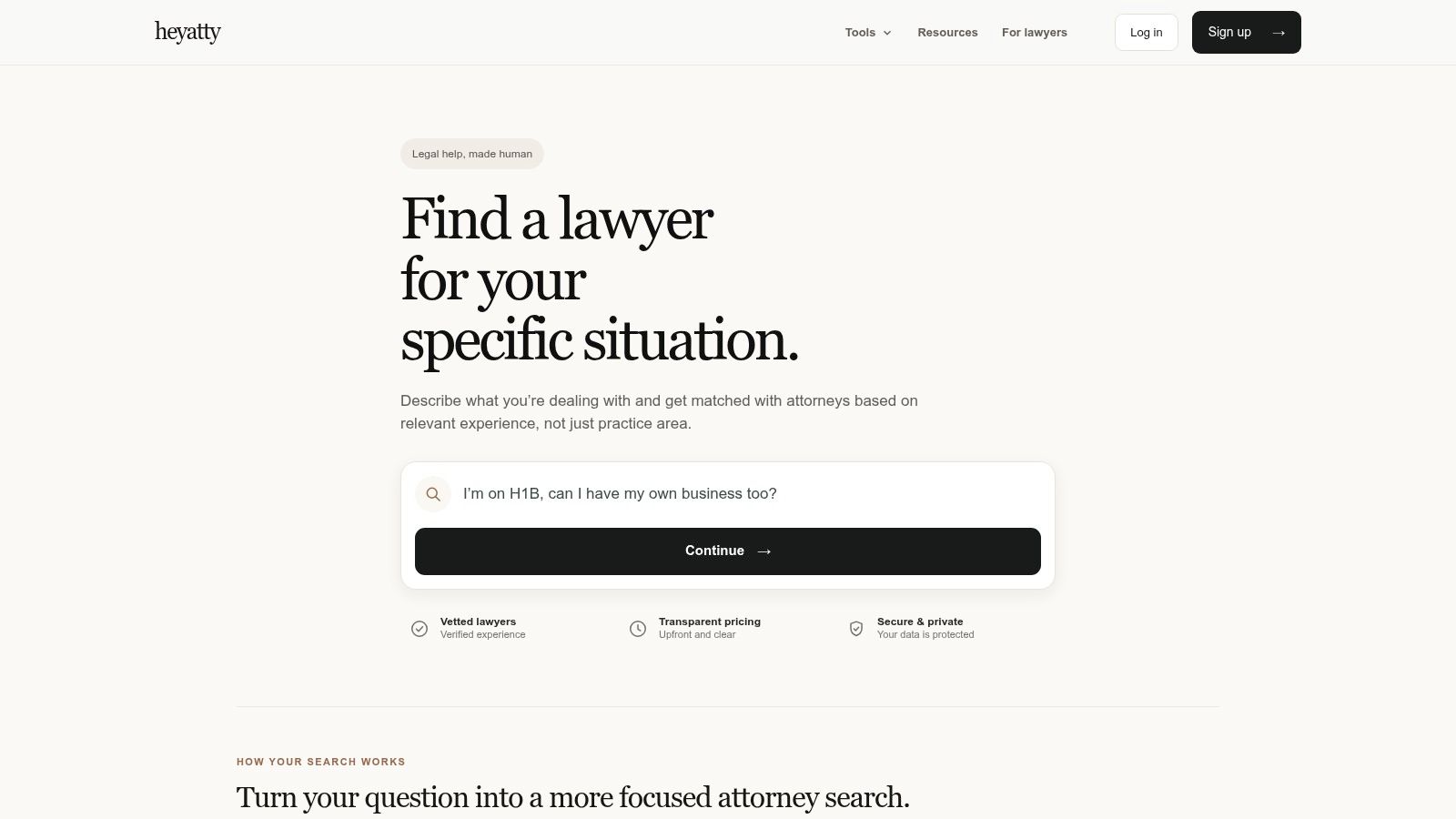
HeyAtty lets users describe a legal situation through guided intake, review attorney profiles, see available consultation pricing and times, and book securely. For a marriage case, the useful outcome isn't a long directory. It's a short list of attorneys whose stated experience gives you a reason to ask better questions.
That still requires judgment. A profile isn't a legal opinion, and a match doesn't replace a consultation. Review whether the attorney discusses your route and fact pattern, then use the first call to test the quality-control process described above. Ask who will handle the case, what the engagement includes, and whether the attorney has identified any immediate risk.
The platform also provides a community Q&A that can help you understand the vocabulary before your call. Use that material for orientation, not as a substitute for individualized legal advice. Immigration consequences depend on facts that a public answer can't evaluate.
Understanding Legal Fees and Spotting Red Flags
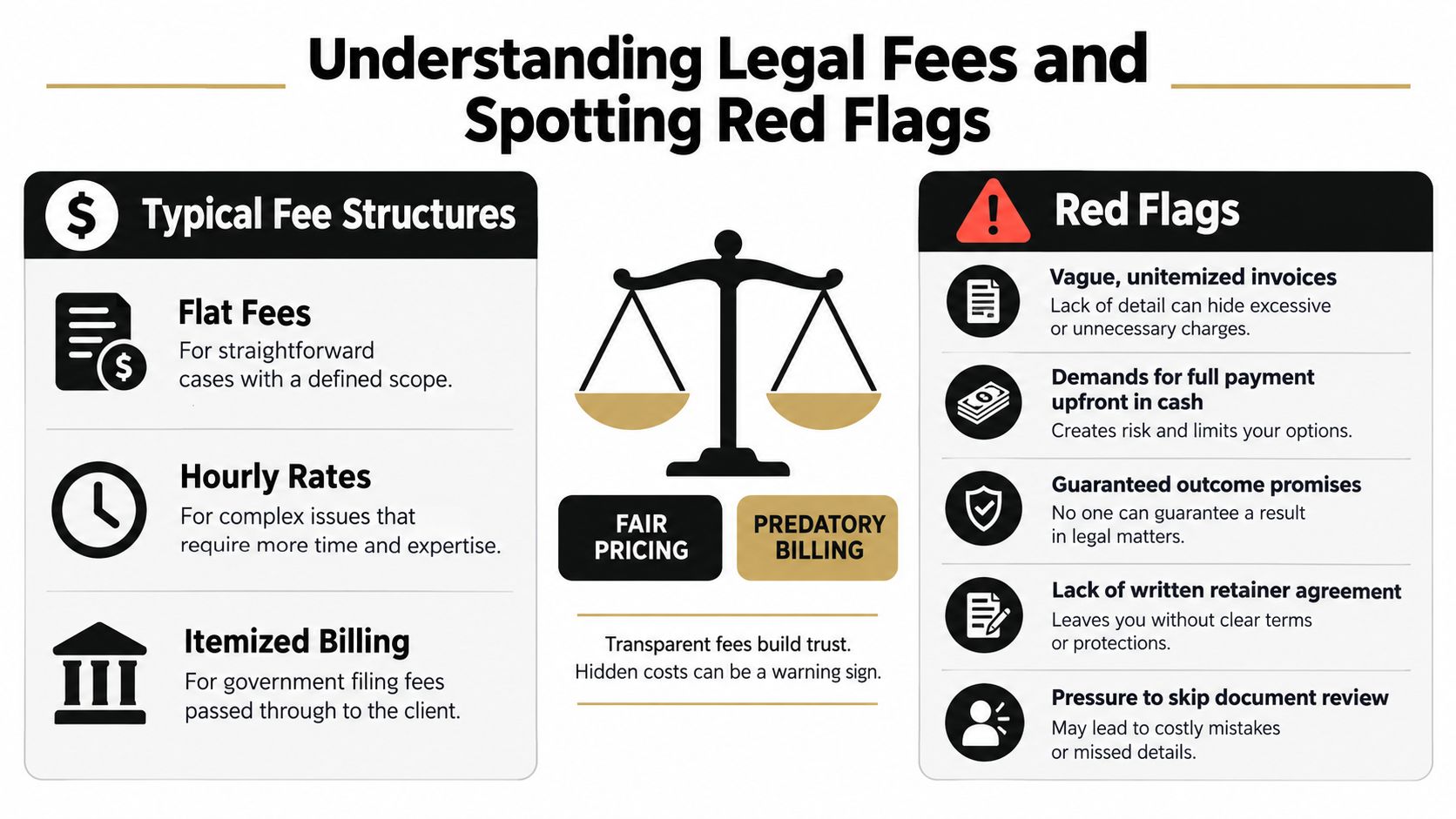
The cheapest quote isn't necessarily the least expensive option. A flat fee that excludes evidence review, interview preparation, Requests for Evidence, or consular complications can become costly when the case encounters the first problem. A higher quote may be reasonable if it covers a difficult admissibility analysis, extensive document review, or representation through a defined stage.
The fee structure should match the case. Straightforward work is often offered through a flat arrangement. Complex matters may require hourly work because the attorney can't responsibly predict how much investigation or strategy the history will require. Government filing fees, medical examinations, translations, travel, and outside professional services should be separated from attorney compensation.
Read the agreement before paying
Your written representation agreement should identify the exact services, the stage covered, communication expectations, responsible attorney, payment schedule, treatment of filing costs, and what happens if the case becomes contested or requires a waiver. It should also say whether Requests for Evidence, interview attendance, motions, appeals, or removal proceedings are included or billed separately.
Ask these questions:
- What does the flat fee cover? Get each stage in writing, including document review and interview preparation.
- What triggers hourly billing? The agreement should define additional work rather than leave it to a vague “complexity” clause.
- Who pays government charges? Require an itemized list and confirmation that those amounts aren't disguised attorney fees.
- What happens if facts change? Ask how the firm handles a discovered overstay, prior removal order, criminal record, or possible misrepresentation.
- What communication is included? Clarify response channels and whether routine status updates cost extra.
You can use this explanation of immigration lawyer consultation fees to prepare for a pricing conversation, but the signed engagement letter controls the relationship.
Walk away from dangerous promises
No responsible attorney can guarantee approval. Walk away if someone tells you to omit an overstay, conceal a prior marriage, alter documents, rehearse a false answer, or pay immediately in cash without a written agreement. Those aren't harmless shortcuts. They can create misrepresentation problems that outlast the original filing.
Also reject invoices that contain unexplained blocks of time, unexplained “processing” charges, or repeated administrative fees with no description. A fair arrangement makes you understand what you're paying for before the work starts.
Red flag: If the lawyer refuses to discuss the bad facts until after you pay, you haven't received a meaningful legal evaluation.
Preparing for Your First Legal Consultation
Two days before the consultation, don't try to create a perfect case file. Create a reliable fact file. Your lawyer needs the truth in chronological order, including the facts you'd rather not discuss.
Start with a shared timeline. Record when you met, how the relationship developed, visits, engagement, marriage, residences, employment changes, periods apart, immigration entries, visa applications, and prior marriages. Add the source document beside each event when you have one. If you don't know an exact date, mark it as approximate rather than guessing.
Build a compact consultation packet
Create one folder with clearly named files or a short document containing:
- Identity records: Passports, birth certificates, marriage certificate, divorce decrees, and name-change documents.
- Immigration history: Visa applications, entry records, approval notices, Requests for Evidence, denials, removal documents, and prior correspondence.
- Relationship proof: Travel records, photographs organized by date and location, communication samples, family statements, insurance, shared responsibilities, and financial records that reflect your actual arrangement.
- Problem facts: Overstays, unauthorized employment, arrests, prior misrepresentation, status violations, border encounters, or unexplained gaps in the timeline.
- Decision questions: Whether to marry abroad or use a fiancé(e) route, whether adjustment is available, whether travel or work is urgent, and what evidence is missing.
Don't bury the difficult issue under screenshots. Put it on the first page with a plain explanation. A prior visa denial, separate household, or missing joint account is manageable only after counsel knows it exists.
Use the consultation to make a hiring decision
Give the attorney a concise narrative, then listen. Does the lawyer ask about lawful entry, current status, prior marriages, admissibility, and documentary inconsistencies? Do they distinguish what they know from what requires further investigation? Do they explain the procedural route without promising an outcome?
Write down the proposed next steps, missing records, scope of representation, fee structure, and risks. Compare answers across consultations using the same questions. The questions to ask before hiring a lawyer can help you keep that comparison consistent.
You should leave with a clearer route and a list of concrete tasks. If you leave with only reassurance, a generic document checklist, and pressure to sign immediately, you haven't received enough information to hire confidently.
HeyAtty offers guided intake, attorney profiles with relevant experience, consultation pricing and availability, and secure booking for immigration legal consultations. Describe the facts that make your marriage case unusual, compare counsel on actual fit, and visit HeyAtty to find a more focused starting point.