
How Long Does H1B Transfer Take Timelines Explained
Wondering how long does H1B transfer take? See premium vs standard timelines, stages, delays, and when you can start work.
With premium processing, USCIS guarantees an initial action on an H-1B transfer within 15 business days after it accepts the premium request. Without premium processing, the transfer commonly takes about 2 to 6 months, while the full employer-to-decision path in a premium case often runs about 4 to 6 weeks once preparation and filing are included.
You've accepted a new job, but your start date still depends on several moving parts. Your new employer needs to prepare the Labor Condition Application, collect documents, assemble the petition, and get the filing properly received by USCIS. At the same time, you may be trying to choose a last day with your current employer, plan payroll, decide whether international travel is safe, and explain to a new manager why “15 business days” doesn't always mean an approval in 15 business days.
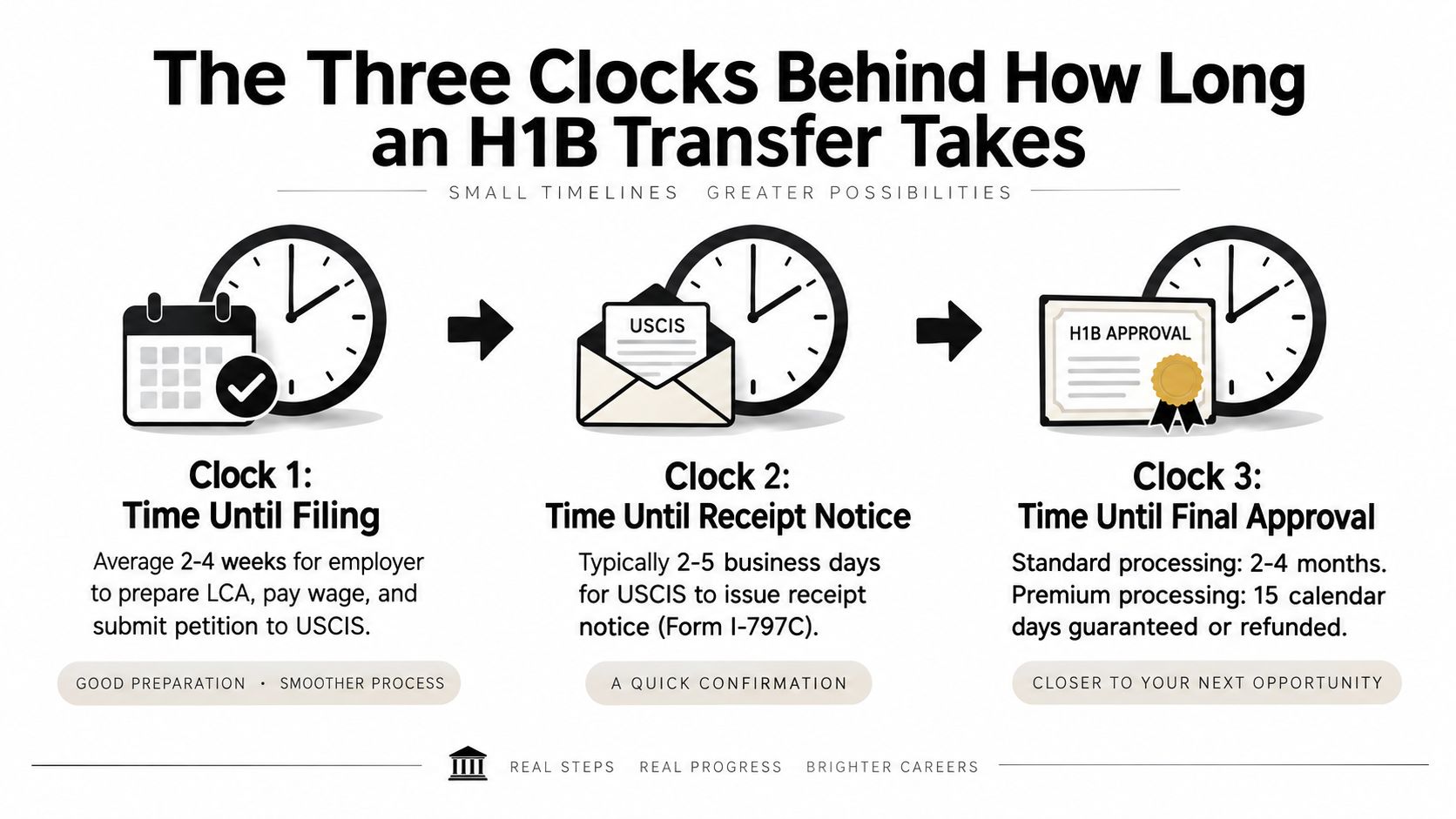
That confusion comes from treating the H-1B transfer as one clock. It's more useful to think of three separate clocks: time until filing, time until a receipt notice, and time until final approval. The earliest clock may control when you can start working, while the last clock controls when USCIS reaches a final decision.
Table of Contents
- Introduction Why Transfer Timing Feels So Uncertain
- Understanding What an H1B Transfer Really Means
- The Three Clocks Behind How Long an H1B Transfer Takes
- Premium Processing Versus Standard Processing Compared
- What Speeds Up or Slows Down Your Transfer
- Sample Timelines for Common Transfer Scenarios
- Planning Your Next Step and Booking Counsel on HeyAtty
Introduction Why Transfer Timing Feels So Uncertain
Maya receives a written offer on a Monday. Her new employer wants her to join quickly, but she doesn't want to resign before she understands the immigration timing. Her recruiter says the case can use premium processing. A colleague says an H-1B transfer takes months. An online search produces both answers, and neither one tells Maya the question she cares about: When can I safely begin the new job?
That question is different from asking when USCIS will issue a final approval. In a qualifying change-of-employer case, portability rules may allow an H-1B worker to begin for the new employer after a properly filed petition, subject to the worker's eligibility and the filing's quality. Many employers still prefer to see a USCIS receipt notice before onboarding because it gives HR a concrete record for its internal employment authorization process.
The timing also depends on work performed before USCIS gets involved. A new employer and its legal team must align the job duties, worksite, offered wage, employee's immigration history, and supporting documents. If the petition is incomplete or the facts need closer review, the filing date moves later even if premium processing is eventually selected.
The practical question isn't only “When will USCIS decide?” It's also “When will the employer file, when will the receipt arrive, and what milestone does HR require before I start?”
A useful list of questions to ask before hiring a lawyer can help you get direct answers about filing readiness, portability, travel, and evidence gaps. By separating the timeline into distinct milestones, you can replace a vague promise with a planning window that makes sense for your actual job change.
Understanding What an H1B Transfer Really Means
“Transfer” is convenient shorthand, but it can create the wrong mental picture. USCIS isn't moving your existing approval from one company to another. Your new employer files a new Form I-129 petition requesting a change of employer, generally relying on your earlier cap count when you were already counted against the H-1B cap.
Think of your current H-1B employment as a relay race. Your current employer is holding the baton represented by the existing approved petition. When you change employers, the old employer doesn't hand its petition to the new employer. Instead, the new employer enters the race with a new petition and must show that its job, wage, worksite, and business facts independently support H-1B classification.
The new petition still needs a sound foundation:
- The employer's role: The position must fit the H-1B requirements, including the specialty occupation analysis.
- The Labor Condition Application: The employer needs an LCA covering the offered employment and relevant worksite.
- Your qualifications: Degrees, transcripts, prior approvals, immigration history, and employment records may all matter.
- Your status history: Pay records and employment dates can help establish that you maintained H-1B status before the change.
A transfer is also different from an amendment. A transfer concerns a new employer. An amendment generally concerns a material change with the same employer, such as a significant worksite or duty change. If your situation involves both a new company and a changed worksite, counsel should review the facts rather than relying on the label “transfer.”
When portability may let you start
If you meet the portability requirements, the new petition is nonfrivolous, and it's properly filed while you're eligible, you may be able to start the new job before final approval. That doesn't make every filing safe. A denial, status issue, worksite mismatch, or weak petition can create serious problems.
A lawyer who regularly handles employment immigration can help the employer distinguish a routine filing from a case that needs closer review. You can use HeyAtty's employment visa lawyer directory as one way to identify counsel whose practice matches the type of H-1B change you're considering.
The Three Clocks Behind How Long an H1B Transfer Takes
The most accurate answer to how long does H1B transfer take is a sequence, not a single duration. Each stage answers a different practical question, and the stages don't all belong to USCIS.
Clock one is time until filing
This clock begins when you accept the offer and ends when the employer submits a properly prepared petition. The employer and legal team must develop the job description, confirm the worksite and wage information, prepare the LCA, gather corporate records, and collect your immigration documents.
That preparation can be the difference between an early filing and a late filing. USCIS's premium clock doesn't start when the employer first emails you a questionnaire or when a courier picks up a package. It starts after USCIS accepts the premium request.
Clock two is time until receipt
The receipt notice confirms that USCIS accepted the petition for processing and provides a case number. This milestone often matters to HR, payroll, and onboarding teams, even though it isn't the same as approval.
A receipt can also help document the filing date for portability analysis. You shouldn't assume that a mailed petition has already reached the legal milestone that matters. Delivery, intake, rejection, and acceptance are different events.
Clock three is time until final approval
Standard adjudication commonly takes about 2 to 6 months, with some cases taking longer depending on workload, service center, and complexity, as summarized in current H-1B transfer timeline guidance. Premium processing changes the speed of USCIS's initial action, but it doesn't erase the first clock or guarantee that the action will be an approval.
A receipt answers “Has USCIS accepted the filing?” An approval answers “Has USCIS granted the petition?” Those answers serve different planning needs.
This structure explains why one person may say a transfer took weeks while another says it took months. The first may be describing time to start work or receive a receipt. The second may be describing final adjudication.
Premium Processing Versus Standard Processing Compared
Premium processing and standard processing use the same underlying petition strategy. The meaningful difference is how quickly USCIS must take an initial action after it properly receives and accepts the premium request.
| Feature | Premium Processing | Standard Processing |
|---|---|---|
| USCIS timing commitment | Initial action within 15 business days after acceptance of the premium request, as described by USCIS premium processing instructions | No comparable guaranteed initial-action window |
| What the action may be | Approval, denial, Request for Evidence, or Notice of Intent to Deny | Final decision or another case action under the ordinary process |
| Typical adjudication picture | USCIS action is faster, but employer preparation and follow-up can make the full path about 4 to 6 weeks | Commonly about 2 to 6 months, with wider variation in some cases |
| Fee cited in recent guidance | $2,965 | No premium surcharge |
| Best planning use | Time-sensitive onboarding, travel planning, or a need for faster case clarity | A case where the worker can rely on portability and doesn't need an accelerated USCIS action |
The most important word in the premium column is initial. USCIS's commitment isn't a promise of approval. If the agency issues an RFE or a Notice of Intent to Deny, the employer must respond, and the case may continue beyond the headline window.
The second important word is acceptance. The premium clock doesn't begin merely because the employer mailed the petition. USCIS must receive and accept the premium request, and the filing must be routed correctly. Preparation, delivery, intake, and any rejection risk sit outside that 15-business-day commitment.
Standard processing trades speed for lower cost. It can work when you're eligible to begin under portability, your employer is comfortable with a pending petition, and international travel or final approval isn't immediately important. But ordinary adjudication is less predictable because service-center workload and case complexity can vary.
Premium processing is most useful when certainty has a deadline. A new employer may need a decision before a relocation, a major client assignment, or planned travel. It's less useful as a substitute for careful eligibility analysis. Paying for speed won't repair an inaccurate worksite, missing status records, or an unsupported specialty occupation explanation.
What Speeds Up or Slows Down Your Transfer
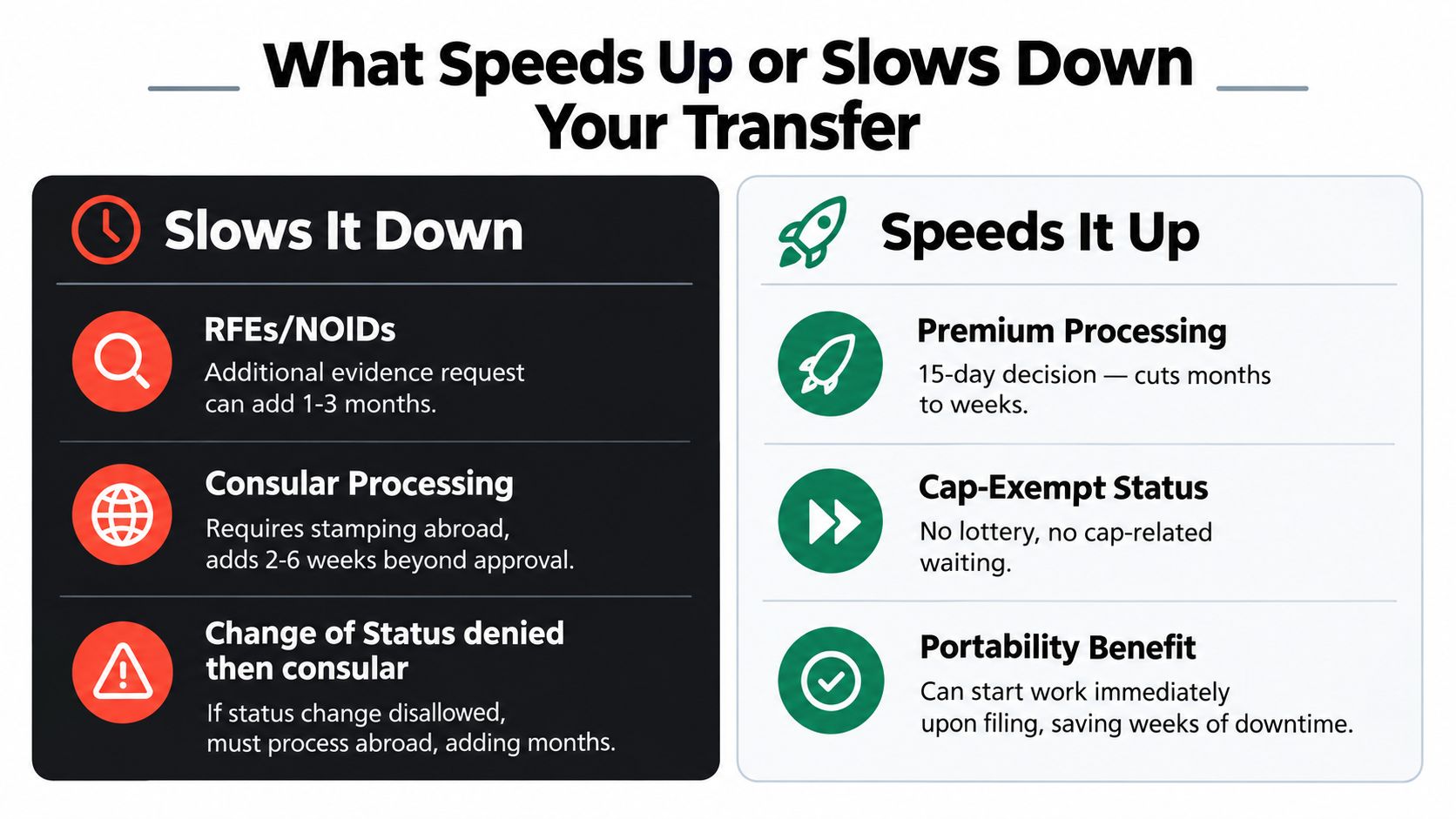
A fast processing choice can't compensate for a filing that reaches USCIS late or lacks necessary evidence. The timeline is shaped by both pre-filing readiness and post-filing friction.
Employer preparation comes first
The employer controls many early steps. Delays can arise when the legal team is waiting for a detailed job description, organizational information, worksite details, wage data, or documents from you. A prompt response helps, but rushing the petition can create inconsistencies that lead to more serious delays later.
Gather your prior approval notices, current I-94 record, passport information, degree records, and employment evidence early. If you've recently changed jobs, had a gap in payroll, worked at a client site, or faced a layoff, tell counsel before filing. Those facts are easier to evaluate before the petition is assembled.
RFEs and Notices of Intent to Deny create a second phase
An RFE asks the employer to provide more evidence. A Notice of Intent to Deny signals a more serious concern. Either one can turn a short initial window into a longer process because the employer must analyze the issue, prepare a response, and wait for USCIS to continue adjudication.
Common pressure points include:
- Job duties: The petition may need a clearer explanation of why the role qualifies as a specialty occupation.
- Worksite arrangements: Client-site, hybrid, or remote work can require precise documentation.
- Status maintenance: Pay records and employment dates may become important if USCIS questions your prior H-1B history.
- Wage consistency: The offered wage, LCA, petition, and support letter should tell the same story.
Travel can change the practical path
International travel during a pending change-of-status filing can complicate the case. Departure may affect the change-of-status portion and may lead to consular processing requirements. If travel is on your calendar, review it with counsel before booking flights.
Workload varies by service center
The USCIS archive on premium processing for H-1B petitions illustrates why premium processing is often discussed as a predictability tool, not an approval guarantee. Independent guidance also describes meaningful service-center variation, so a standard estimate should be treated as a planning range rather than a promise.
Layoffs add urgency because the new filing may need to support a portability position while your employment history is still clear. A new employer should understand the dates, records, and status facts before deciding how quickly to file.
Sample Timelines for Common Transfer Scenarios
These examples are planning stories, not guarantees. They show how the three clocks can produce different answers for different workers.
A clean premium case
Daniel accepts a job while remaining employed by his current H-1B sponsor. The new employer starts the LCA and petition preparation immediately. After the evidence is assembled, the employer files with premium processing.
The filing date is the first major milestone. Once the petition and premium request are accepted, USCIS has 15 business days to take an initial action. If USCIS approves the petition without requesting more evidence, Daniel may receive final clarity within the premium window, but the employer-to-decision journey still includes preparation, delivery, intake, and acceptance.
His manager may want a start date tied to the filing or receipt, while HR may want the receipt notice for its records. Daniel should ask which document the employer requires rather than assuming that “premium” answers the onboarding question.
A standard case with no immediate travel
Leah's new employer has a complete role description and no urgent international travel is planned. The employer files without premium processing, and Leah may be able to rely on portability if she meets the applicable requirements.
Her practical timeline has an early filing milestone, a receipt milestone, and a much later final-decision milestone. Standard adjudication commonly takes 2 to 6 months, and the case may remain pending while she works for the new employer under the applicable portability rules.
The uncertainty is concentrated in the final clock. Leah may be able to start earlier, but she still needs to preserve the documents supporting the filing and respond promptly if USCIS requests evidence.
A premium case with an RFE or travel issue
Arun's employer selects premium processing because he needs a faster answer. USCIS takes an initial action within the required window, but the action is an RFE rather than an approval. The employer must now prepare a response, perhaps addressing job duties, worksite details, or status records.
The original headline window no longer represents the full path to approval. If Arun also leaves the United States while a change-of-status request is pending, the travel plan may create a separate consular-processing issue. His case has moved from a simple fast track to a sequence involving evidence and travel strategy.
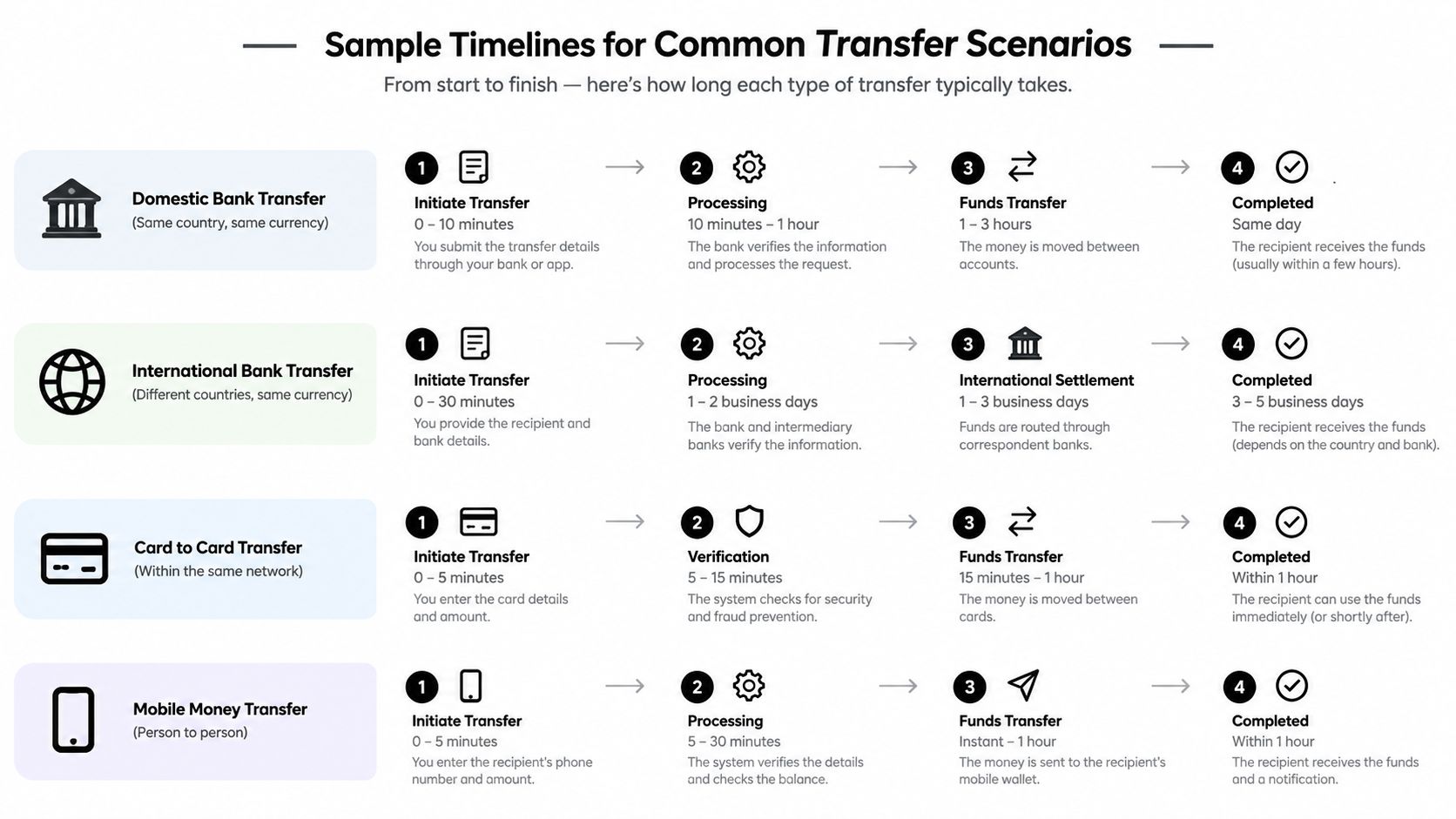
The pattern is consistent: filing controls the earliest work-start analysis, receipt supports documentation, and approval closes the USCIS decision clock.
Planning Your Next Step and Booking Counsel on HeyAtty
Your urgency should determine what you do next. If your current job is ending, your I-94 date is approaching, or your new employer expects a rapid start, waiting to discuss the case can shrink your options. If travel is planned, raise it before the petition is filed, not after tickets are booked.
Prepare a compact document folder for the first consultation:
- Immigration history: Prior H-1B approval notices, visa pages, passport identity page, and I-94 record.
- Employment records: Recent pay evidence, current employer details, and the expected last day of work.
- New-job facts: Offer letter, job title, duties, salary information, worksite, and whether the role involves a client.
- Timing questions: Desired start date, travel plans, premium-processing preference, and what the new employer has already completed.
- Risk facts: Layoff history, employment gaps, prior RFEs, status concerns, or changes in remote-work location.
Ask counsel to identify the three dates that matter in your case: the target filing date, the expected receipt milestone, and the realistic approval window. You should also ask whether you may start under portability, what evidence supports that position, and what happens if USCIS issues an RFE or denial.
A consultation with an immigration lawyer can help you turn those questions into a case-specific plan. HeyAtty lets users compare vetted legal professional profiles, review availability and pricing, and book through its platform, so you can look for counsel whose experience fits the urgency and facts of your H-1B change.
HeyAtty offers a practical way to compare immigration lawyers by profile, availability, and consultation pricing before you book. Visit HeyAtty to find counsel who can review your filing, receipt, portability, travel, and approval timeline with you.