
Small Business Lawyer Guide for Founders and Owners
Learn what a small business lawyer does, when to hire one, what it costs, and how to choose the right small business lawyer for your stage.
You sign a lease for your first workspace, hire someone to take work off your plate, and accept a customer's promise to pay later. None of these decisions feels like a legal event. Yet each one creates obligations, assigns risk, and can affect your cash flow long after the excitement of growth has faded.
That's why a small business lawyer is more than someone you call after receiving court papers. The right lawyer acts as a risk manager, translating your commercial goals into contracts, ownership structures, employment practices, and payment systems that can withstand ordinary business pressure. This guide explains what that work looks like, when early advice makes sense, how fees are structured, and how to choose counsel who fits your company's stage.
Table of Contents
- Introduction Why Every Small Business Eventually Needs Legal Guidance
- What a Small Business Lawyer Actually Does for Your Company
- Core Service Areas Every Owner Should Understand
- When to Hire a Small Business Lawyer and When You Can Wait
- How Small Business Lawyers Charge and What to Expect
- How to Choose the Right Small Business Lawyer for Your Stage
- Building a Legally Resilient Business From Day One
Introduction Why Every Small Business Eventually Needs Legal Guidance
A founder named Maya lands her first large customer. The customer sends a short agreement, asks Maya to sign quickly, and promises that the document is “standard.” Maya notices the payment section but skims the rest. A few months later, the customer disputes the quality of the work, withholds payment, and points to a broad limitation-of-liability clause that Maya didn't understand.
Maya's problem didn't begin when the customer stopped paying. It began when a business opportunity moved faster than her legal review process. The same pattern appears when an owner signs a commercial lease, brings in a co-founder, hires a contractor, or changes how the company is taxed. A routine decision becomes expensive when nobody has clarified who is responsible, what happens if expectations change, or how either side can exit.
Small firms have less room to absorb those mistakes. A 2023 U.S. Chamber Institute for Legal Reform report found that commercial liability costs in the U.S. tort system totaled $347 billion in 2021, with small businesses absorbing $160 billion. Small businesses generated 20% of revenue but bore 48% of commercial tort costs, while firms with $1 million or less in annual revenue faced tort costs seven times higher relative to revenue than firms with $50 million or more.
Practical rule: Treat legal advice like maintenance for a delivery vehicle. You want to find the worn brake pad before the accident, not after.
The encouraging part is that legal guidance doesn't always mean a large, open-ended engagement. Sometimes it's a focused review of a contract, a conversation about founder ownership, or a plan for collecting a late invoice. The following sections build a practical model for deciding what help you need and when to seek it.
What a Small Business Lawyer Actually Does for Your Company
Think of your business as a building. You choose the purpose, layout, and occupants. A lawyer checks whether the foundation, wiring, entrances, and safety systems support the way you plan to use the building. They don't decide what kind of company you should build, but they help ensure your commercial choices have a structure the law can recognize and enforce.
A small business lawyer translates between two languages. You speak in terms of customers, margins, hiring, delivery dates, and growth. The legal system speaks in terms of obligations, remedies, ownership, liability, evidence, and procedure. Good counsel connects those languages without burying you in jargon.
The difference between reacting and managing risk
Reactive legal work begins after something has gone wrong. A customer refuses to pay, an employee makes a complaint, a partner wants out, or a competitor uses your branding. The lawyer then focuses on preserving evidence, assessing exposure, negotiating, or defending a claim.
Preventive legal work begins earlier. The lawyer reviews how the business operates and asks practical questions:
- Who owns the work product? A contractor agreement may need clear intellectual-property language.
- When does payment become due? A vague invoice process can make collection harder.
- What happens when someone leaves? Ownership, confidentiality, and transition terms should be addressed before emotions rise.
- What can the business afford to lose? Liability allocation and insurance decisions should reflect actual financial capacity.
The value of this work often appears as a problem that never becomes a dispute. A general business lawyer may handle formation, contracts, routine employment questions, and negotiations. A specialist may be appropriate for complex tax matters, regulated industries, patents, immigration, or active litigation.
A lawyer doesn't replace your business judgment. They help you make that judgment with fewer hidden liabilities.
Core Service Areas Every Owner Should Understand
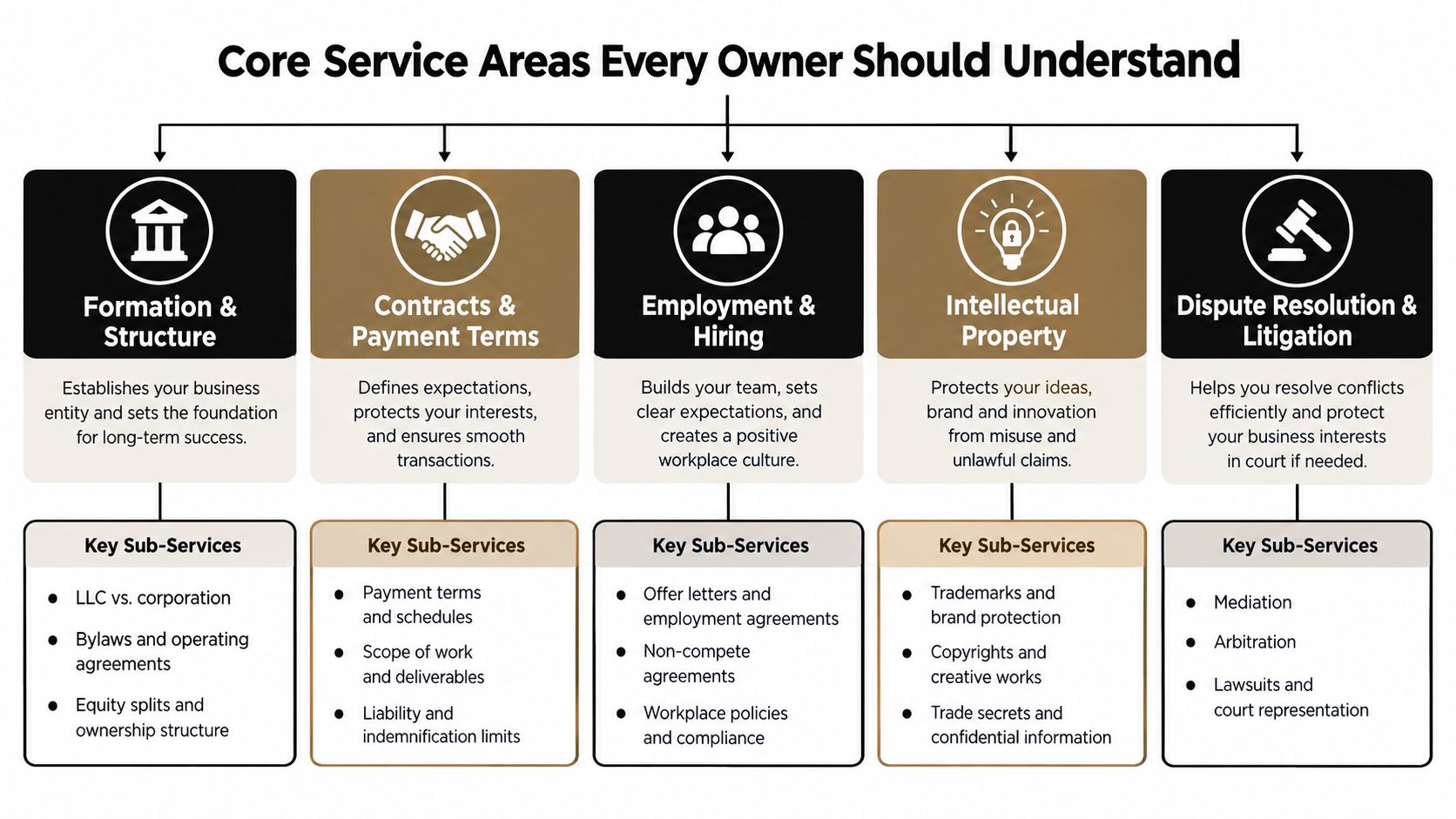
Legal needs follow the life of a company. Formation decisions influence ownership. Ownership affects authority and responsibility. Contracts determine how the company earns and pays money. Employment and intellectual-property practices protect the systems that deliver the work. Dispute procedures provide an escape route when relationships break down.
Formation and structure
The entity choice is not just a filing task. An LLC, corporation, or partnership can create different governance, ownership, and liability considerations. A lawyer can help founders document equity splits, voting rights, contributions, decision-making authority, and departure terms before assumptions turn into conflict.
Two founders might agree informally that they “own everything together.” That phrase leaves unanswered questions about unequal funding, intellectual property, deadlock, and what happens if one founder stops working. A written operating agreement or shareholder arrangement gives the business a decision system instead of relying on memory.
Contracts and payment terms
Contracts are the operating instructions for commercial relationships. A lawyer can clarify scope, deliverables, acceptance standards, payment dates, late-payment consequences, change orders, confidentiality, liability limits, and termination rights.
Payment disputes deserve special attention because they affect the money a business has already earned. In Australia, public-sector data for 2022–23 identified payment disputes as the most common matter handled for small and family businesses at 38%, followed by contract disputes at 25% and franchising-code issues at 12%, as reported in the Federation of Small Businesses dispute-resolution research. The jurisdiction differs, but the lesson is broadly useful: payment language and enforcement mechanics deserve more attention than a rushed signature usually receives.
For a focused review of commercial agreements, owners can also consult guidance on a business contract lawyer.
Employment and hiring
The first employee changes the company's risk profile. Offer letters, classification, pay practices, workplace rules, confidentiality, leave, discipline, and termination language all need to match the business's location and actual practices. A title alone doesn't determine whether a worker is exempt from overtime rules, and an informal promise can create confusion about job security or compensation.
Intellectual property and compliance
If your company creates software, designs, training materials, brand assets, or confidential processes, ownership should be documented. Trademarks, copyrights, trade secrets, and invention assignments address different kinds of protection. Compliance work may also involve industry rules, licenses, privacy obligations, advertising requirements, or recordkeeping.
Dispute resolution and litigation
A dispute plan should begin before a lawsuit. The contract can identify notice procedures, negotiation steps, mediation, arbitration, venue, and governing law. If escalation becomes necessary, counsel can preserve documents, evaluate the claim, and choose a response that protects both the company's position and its operating capacity.
When to Hire a Small Business Lawyer and When You Can Wait
Many owners ask, “Can I handle this myself?” Sometimes the answer is yes. The more useful question is whether you can identify the legal issue accurately, understand the consequence of each option, and create records that will support your position later.
The Legal Services Board's small-business research found that 32% of small businesses experienced at least one legal issue in a year, while only about 25% used professional legal help. Many owners tried to solve problems themselves or took no action. That behavior is understandable when cash is tight, but delay can allow a late payment, employment concern, or regulatory notice to become harder to classify and more expensive to resolve.
Use an early-triage test
A useful test has three questions:
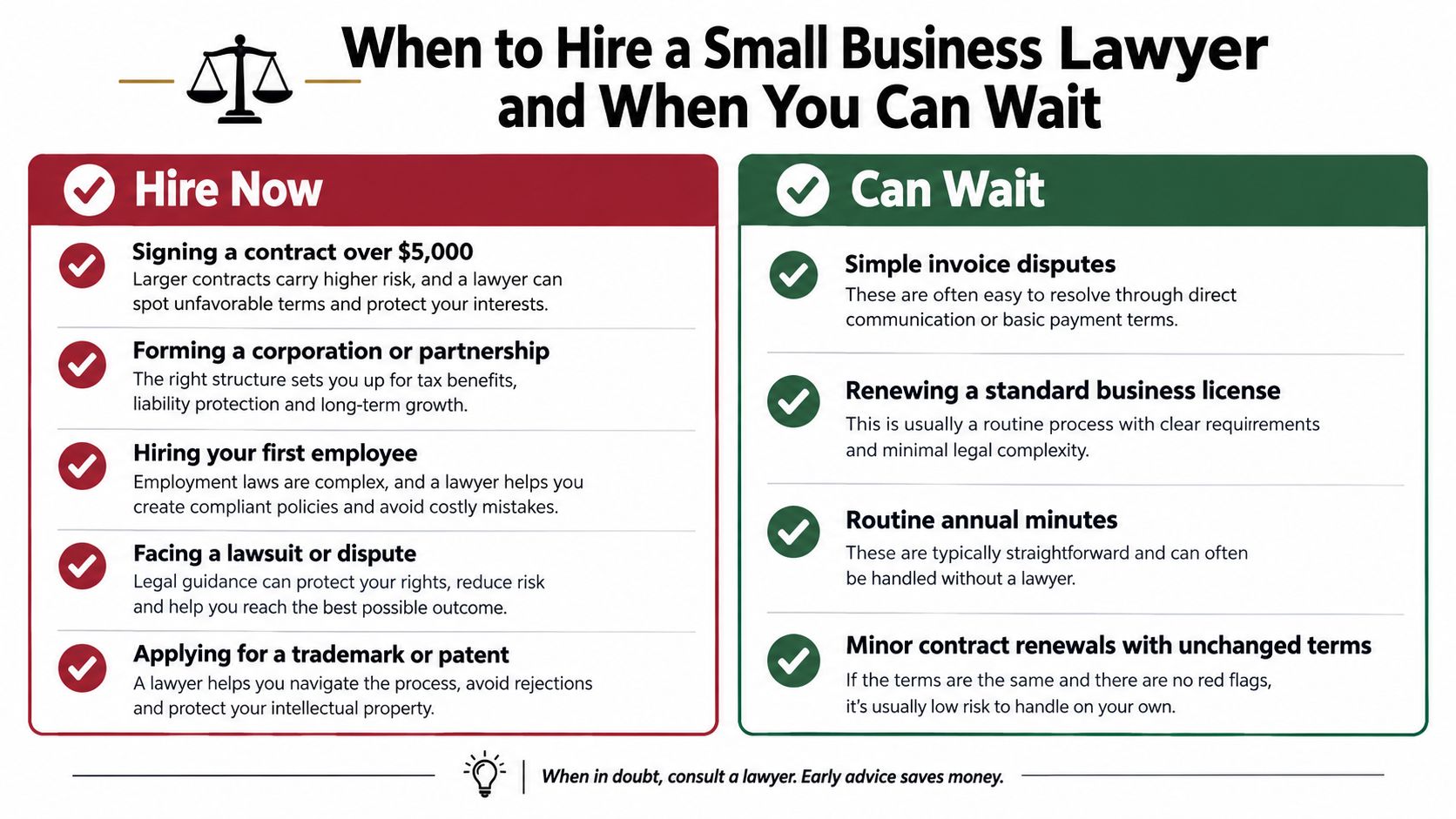
- Could this decision change ownership, liability, employment rights, or intellectual-property ownership? If yes, get advice before committing.
- Could the other party use this document against the company? If yes, have the contract reviewed.
- Will delay reduce your options? Unpaid invoices, threatened claims, preservation of evidence, and official notices often become more difficult with time.
The scale of the burden makes this timing decision important. The U.S. Chamber report cited earlier found that small businesses carried a disproportionate share of commercial tort costs, especially relative to revenue. Prevention can therefore protect more than legal fees. It can protect payroll, supplier relationships, management attention, and the ability to keep serving customers.
Common moments for prompt advice
Call a lawyer early when you're forming or restructuring the company, changing ownership, signing an important lease, hiring your first employee, receiving a demand letter, or facing a government inquiry. A lawyer can often begin with issue classification rather than a full litigation engagement.
Routine administrative work may not require immediate counsel when the facts and terms are unchanged. Still, “standard” should mean you've confirmed that the document fits your business, not merely that someone sent it to you.
Decision filter: If the downside could threaten the company's cash flow or control, spend on clarity before you spend on repair.
How Small Business Lawyers Charge and What to Expect
Fee structure should match the shape of the legal problem. A clean contract review has a defined boundary. A dispute may expand as facts emerge. An ongoing company with recurring questions may prefer predictable access to counsel rather than starting from zero each time.
| Engagement Model | Best For | Cost Predictability |
|---|---|---|
| Hourly billing | Open-ended advice, negotiations, investigations, and disputes | Lower, because the final amount depends on time |
| Flat fee | Defined matters such as formation documents, a contract review, or a specific filing | Higher, when the scope and deliverables are clear |
| Retainer | Repeated access to counsel and ongoing business questions | Varies, depending on included work and billing terms |
| Project-based fee | A contained business project with several connected deliverables | Moderate to high, if assumptions and exclusions are written down |
Market expectations are changing. In Clio's 2025 Legal Trends report for solo and small firms, 75% of solo firms and 65% of small firms offered flat fees alongside hourly billing, and 80% of solo legal professionals used flat fees for entire matters. The same report said 72% of solo legal professionals and 67% of small-firm legal professionals used AI in some capacity. These figures don't tell you which lawyer is right, but they do support asking about modern delivery methods, review procedures, and the human judgment included in the fee.
Before signing, ask what you'll receive, what facts the quote assumes, who performs the work, how revisions are handled, and what falls outside scope. Also ask whether the initial consultation is billed separately. A plain explanation of legal consultation fees can help you prepare better questions before booking.
How to Choose the Right Small Business Lawyer for Your Stage
A lawyer who is excellent at defending lawsuits may not be the right person to document a two-founder startup. A formation lawyer may not be the right fit for an urgent employment investigation. Choose by matter fit, not by a general impression of seniority.
Start with the problem, not the title
Write a short description using business language. “A customer has withheld payment after delivery” is more useful than “I need a business lawyer.” “My co-founder wants to leave and owns half the company” immediately points toward ownership, governance, contracts, and negotiation.
Then look for experience with the actual situation. Ask whether the lawyer has handled similar agreements, founder departures, payment disputes, employee classifications, trademark filings, or regulated activities. Specific experience helps you assess fit more reliably than a broad practice-area label.
Compare the working relationship
Review each candidate's jurisdiction, services, availability, consultation price, fee model, and communication expectations. You're not only buying legal analysis. You're choosing how quickly questions get answered and whether the lawyer can explain tradeoffs in language you'll use to run the business.
Prepare key documents before the first call:
- The relevant agreement: Include amendments, invoices, emails, and notices.
- A factual timeline: List what happened, when it happened, and who was involved.
- Your desired outcome: Decide whether you want payment, a clean exit, revised terms, or a defensible process.
- Your practical limits: Explain deadlines, budget constraints, and operational concerns.
A structured service such as HeyAtty can let owners compare vetted legal-professional profiles, practice information, pricing, availability, and booking options in one place. Its guided intake and community Q&A can also help an owner identify a likely practice area before the first conversation. Use any directory as a starting point, then verify that the selected professional is licensed for the relevant jurisdiction and suitable for the specific matter.
Building a Legally Resilient Business From Day One
Legal resilience isn't a binder that sits untouched after formation. It's a habit of making important decisions with the right documents, approvals, records, and review points.
A resilient owner keeps contracts organized, follows up on invoices using the agreed process, records ownership decisions, documents employment actions, and revisits key terms when the business changes. Periodic review matters because a contract written for a small pilot may not fit a larger customer relationship, and an ownership arrangement created by two founders may not work after outside investment or a departure.
The commercial case for this discipline is especially strong for smaller firms. The U.S. Chamber's findings show that small businesses can carry a disproportionate legal burden relative to their revenue. Preventive counsel can't remove every risk, but it can help the owner see risk earlier, assign it deliberately, and respond before a manageable issue consumes cash and attention.
When the company is being created or its ownership is changing, focused advice from a business formation attorney can establish a stronger operating foundation. After that, re-engage counsel when the facts change, not only when a conflict becomes urgent.
HeyAtty helps small business owners discover, compare, and book vetted legal professionals using structured profiles, availability, pricing, guided intake, and secure booking. Visit HeyAtty to describe your business issue and find a practical starting point for legal guidance.